Showing posts with label Ohio. Show all posts

Sunday, August 29, 2021

Happy Anniversary Girl Scouts!

 March marks the 109th anniversary of the Girl Scouts.  


In 1912, when U.S. women still did not have the right to vote, Juliet Gordon Low wanted young women to envision all the opportunities available to them. Emphasizing inclusiveness, the outdoors and self reliance, Juliette's girls: 

●  Hiked 

● Camped

● Swam 

● Played basketball 

● Learned to tell time by the stars 

● Studied foreign languages 

● Shared a sense of adventure & belief that they could do anything 

●Offered a helping hand to those in need 

●Made their corner of the world better

Low pinning a badge on a Girl Scout's uniform.
Circa 1912.


Still flourishing today, the Girl Scouts boast over 2.5 million members and over 50 million alums in 92 countries .


Girl Scout troops in Medina County are part of a regional group that has undergone many name changes. First they were called the Akron Area Scouts. Then they became the Summit City Council of the Girl Scouts. Then in 1962 they became the Western Reserve Girl Scout Council. Finally, in 2007 five regional Girl Scout Groups combined to become the Girl Scouts of Northeast Ohio.


Here's some highlights from the last 100 years of Girl Scouts in Medina County with emphasis on the early years of their development.

  • Miss Francelia Stuenckle
    German and Normal School Teacher*
    at the Medina High School.
    1917 -The first troop formed in Medina County was at the Medina High School in the fall of 1917. The United States had just entered World War I. Over 20 girls, all members of the junior class, attended the first meeting held at the Garfield Building (then the high school) in October. Miss Francelia Stuenckle was their scout master.
  • 1918 - The girls are avid hikers, trekking out to L.H. Randall's cabin and later to the Northern Ohio railway.
    • The sell tickets for the Red Cross Pageant, a fundraiser for WWI.
    • The Girl Scouts sell over $1600 War Savings Stamps^ That would be $28,000 in today's dollars. They do so well that the Boy Scouts back off from participating in the program.
    • The Girls jump into selling Thrift Stamps^
    • Miss Stuenckle returns to her hometown of Chicago and Miss Marion Whipple takes over the scouts.
  • 1919 - The Girl Scout presence in Medina County grows as Granger High School and Wadsworth form their own troops.
    • 19 girls attend camp for 10 days at Camp Mittawanda on Lake Erie. Several sets of parents visit their daughters at the camp.
    • In May, the Girl Scouts bring a group of Swiss Bell Ringers to Medina.
    • In December, they have a Christmas Party and later distribute Christmas baskets to the needy.
  • 1920 - The Girl Scout program expands into China, Syria and Mexico. In the U.S., Native American and Mexican American troops form. The Medina Troop spend 2 weeks at Chippewa Lake.
  • 1922 - The Lodi Girl Scouts spend a week at Camp Crag.
Started as a 4-H camp, Camp Crag welcomed many
Scout troops over the years.


  • By 1924, The Girl Scouts in the region had grown to over 20 troops with 700 members
  • 1925 - Sharon Township and Seville Girl Scout troops form.
  • 1930 - Girl Scouts collect food and clothing for those suffering the effects of the Great Depression.
  • 1932 - Camp Ledgewood opened up in Peninsula, OH

Camp Ledgewood is still used by Girl Scouts today.

  • 1936 - Two troops traveled to Camp Ledgewood.
    • The first "colored" troop forms in Medina. They are supervised by Mrs. Will (Sally) Ozier, who is also African American. Her husband supervised the Boy Scout "colored" troop.
    • The village of Medina has three troops of Girl Scouts.
  • 1937 - Disparities are seen; the "colored" troop were getting badges as "laundress", "housekeeper" and "needlewoman", while the other troops are receiving badges in "scholarship", "observer", "swimmer", "gardener", "child nurse" and "artist".
    • All 3 Medina troops attend Camp Crag
    • Medina Girls are getting the highest award. "Golden Eglet" status is awarded to Miss Mary Louise Long and Miss Ramona Everhardt.
  • In 1938, Troop 3, the "colored" troop is recognized by the Girl Scout National Headquarters.
  • 1939 - In the photo below, the girl in the second row, far right is Virginia Wheeler (Martin), who donated the money for the Medina Library Family History and Learning Center that bears her name. 
Oct 24, 1939  Medina Gazette p. 3


Virginia Wheeler's Girl Scout Badges:
Bird Watcher and First Aid
From the collection of Virginia Wheeler Martin.

Girl Scout image from circa 1940.
From the collection of Virginia Wheeler Martin.


Virginia Wheeler's Girl Scout Handbook
for the Intermediate Program, circa 1940
From the Collection of Virginia Wheeler Martin


  • 1940's - Nationally, Girl Scouts  supported the war efforts by operating bicycle courier services, running Farm Aide projects, and along with millions of other Americans, collecting fat and scrap metals and growing Victory Gardens. Internment camps in California and Utah saw the emergence of Girl scout troops among the imprisoned Japanese American girls.
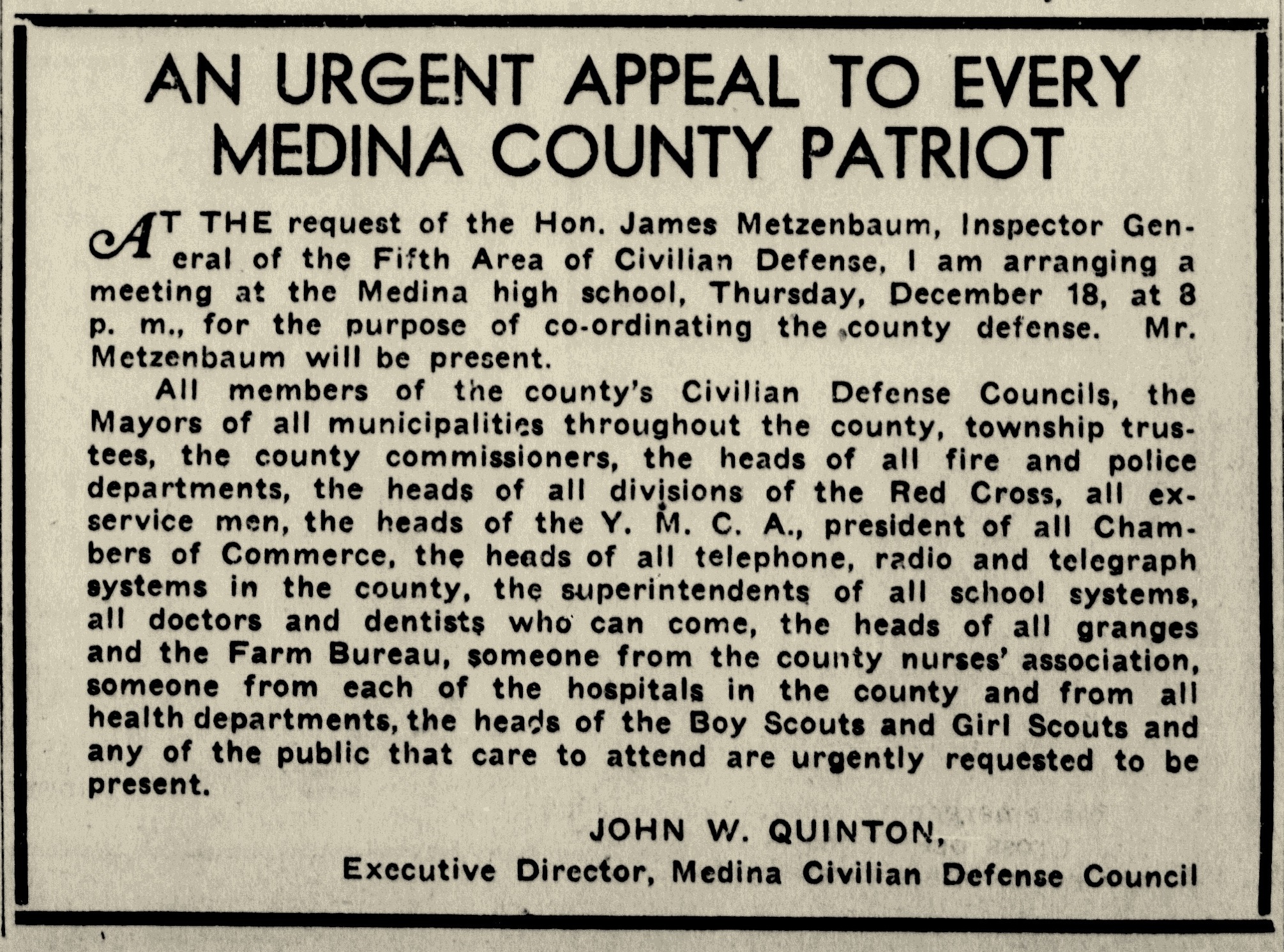
February 9, 1940 Medina Gazette Page 4.
An appeal goes out to area agencies to plan for Civilian Defense.
    • Locally, Medina Girl Scouts sold movie tickets in support of war relief.
    • The decade saw many of the troops selling Girl Scout cookies for the first time.
  • 1950's Girl Scouts assembled "Kits for Korea" to distribute items desperately needed by Korean citizens.
  • 1953 - Celebrating the 41st Anniversary of Girl Scouts
To celebrate the 41st anniversary of the founding of the 
Girl Scouts, the girls baked a cake and presented it to 
the superintendent of the Pythian Sisters Home.
March 17, 1953 Medina Gazette,  p. 1.

  • 1968 - Girl Scouts volunteer at the hospital along side Candy Stripers.
  • 1969 - Brunswick Senior Girl Scouts attend a national meeting at Kent State University where the following topics were discussed:
    • Learning to communication with other people
    • The War in Vietnam
    • Civil Rioting in the U.S. 
    • The males' view of sex, dating & marriage
  • 1969 in October the girls participated in a Dolly Derby, where they dressed the dolls and competed for best dressed. Later the dolls were given to Good Will to be sold in time for Christmas.

Green Leaf Park courtesy of Google Maps


  • 1972 - Local Girl Scout troops plant over 600 trees at the Sharon Gravel Pit Park. The park has since been renamed Green Leaf park. Today, you can't tell that it was once a gravel pit.


  • 1980's - They created the "Contemporary Issues" series  that addressed serious issues such as drug use, child abuse and teen pregnancy.


  • 1989 - Lodi Girl Scouts learn all the tricks of the trade in being a clown.
 February 27,  1989  Review Chronicle Page 10 


  • 1996 - The Girl Scout web site debuted and a Technology Badge was introduced.
  • 2000's focused on the healthy development of girls.
  • 2017 -  Girl Scouts help with the Children's Garden at Heritage Farm in Brunswick. 
    Girl Scouts Morgan Kulka and Lydia Miller work
     on the children’s gardens at Heritage Farm
    in Brunswick. (Photo Courtesy of Scott Miller)
    Cleveland.com

  • Natalie Bair
    Fox News

    2018-2019 - Medina Girl Scouts urge Medina City Council to ban plastic bags.
  • 2020 - 12 year old Natalie Bair received the Girl Scout Medal of Honor for saving her baby brother's life when he choked on a cracker while riding in the car.
  • 2021 - "Made with Code" program encouraged girls to work in computer science. Girl Scout cookies were sold online with "Digital Cookie"


Girl Scout COOKIES

In 1917, Girl Scouts in Oklahoma were baked the cookies themselves and sold them as a fund raisers. In 1922, a simple sugar recipe was shared in the Chicago Council. For years the girls baked and sold the cookies in simple wax paper wrapping.   The price? 25¢

A box of commercially baked Girl Scout Cookies from the 1930's

During World War II, sugar, flour and butter were rationed and in short supply. In 1944, the girls switched to selling calendars as an alternative.

After the war, cookie sales increased and by 1948, 29 commercial bakers were licensed to bake Girl Scout Cookies.

By 1951, the cookies came in 3 varieties; Sandwich, Shortbread with the famous trefoil imprint and Mints. By the 60's the bakers were wrapping the cookie boxes in aluminum foil or cellophane to preserve the cookies' freshness.

The cookie flavors have continually expanded and they now offer 12 varieties, including Trevoil/Shortbread, Thin Mints, Peanut Butter Sandwich and Samoas.

Which is your favorite? And how many did you order this year?


*"Normal School" was a teacher preparation course.
^Both the War Savings Stamps and Thrift Stamps programs were U.S. government projects to help fund the country's participation in World War I.

Ohio Presidents - More Than Just Dates


Many people think genealogy research is just about finding the basic information for their ancestors, i.e. birth, marriage and death records. However, if their research stops there they are missing out on a large part of their ancestor’s life. Finding out about the events which occurred between those dates makes it a family history instead of just a family tree...with all branches and no leaves. 


Since it is February and we celebrate President’s day on the 15th, I thought I would illustrate what I mean by using the Ohio men who became President to show how there is so much more to them than just the dates. 


First, I will give the basic information - The BRANCHES of the Tree 
Then I will add to this information with a little more details of the President's life - The LEAVES of the Tree


William Henry Harrison – 9th President


BRANCHES:

Birth: 9 February 1773

Marriage: 25 November 1795

Death: 4 April 1841 


Harrison's Land Record from www.glorecords.blm.gov


LEAVES:


Harrison was not born in Ohio. He was actually born in Charles City County, Virginia. Ohio claims him as one of theirs, because he settled in Hamilton County, Ohio along the Ohio River early in the state’s history and was living there when he became President. He was also the last President born before the United States became independent.

He married Anna Tuthill Symmes in Hamilton County. However…when he asked Anna’s father, John Symmes, for permission, her father refused. William and Anna had to elope and marry in secret.


Harrison became President on the 4th of March 1841 and delivered a 1 hour and 40 minute inaugural address, the longest in history, in wet and chilly weather. Tragically, he became ill after the inauguration and died 31 days later in Washington D.C. He was the first President to die in office.


Ulysses S. Grant – 18th President


BRANCHES:


Birth: 22 April 1822

Marriage: 22 August 1848

Death: 23 July 1885


LEAVES:

Grant was born in Clermont County, Ohio, a town along the Ohio River. It took his parents over a month to name him. They finally named him Hiram Ulysses. However….the Representative that arranged for his appointment to West Point, submitted his name as Ulysses Simpson Grant. He was never able to get the academy to fix it and supposedly he didn’t care for his original initials, H.U.G., so he just continued to use his new name. 

Grant & Dent Marriage Record
He was introduced to his future wife, Julia Boggs Dent, through her brother who went to West Point with him. There is a story that Grant was riding in a carriage with her and came to bridge where the river was flooding. He assured her he would safely get her across, but she said she would still cling to him no matter what. When they successfully crossed he asked her if she would "cling to him the rest of their lives". He married Julia in St. Louis, Missouri at her family’s plantation. Grant’s parents were so unhappy that he was marrying into a family who held slaves they did not attend the wedding. 

President Grant was in office for two terms, 1869-1877. During his time as President, he supported amnesty for Confederate leaders and protections of the rights of African-Americans. He also signed legislation making Yellowstone National Park one of America’s first national parks. 

Ulysses S. Grant died in Saratoga County, New York from throat cancer. An estimated 1 million persons turned out for his funeral procession. He was temporarily laid to rest near Sarasota Springs, but in 1897, President McKinley had him buried in New York City overlooking the Hudson River. 


Rutherford B. Hayes – 19th President


BRANCHES:

Birth: 4 October 1822

Marriage: 30 December 1852

Death: 17 January 1893


LEAVES:

Hayes was born, two months after his father’s death, in Delaware County, Ohio. He was raised by his mother and his maternal uncle. 
RB Hayes Obituary


He married Lucy Ware Webb in Cincinnati. She was a college graduate from Wesleyan Women’s College making her the first First Lady to have graduated from college. 

Hayes won the 1876 election after a special commission was formed to investigate disputed electoral votes. The tension was so high he had to secretly take the oath of office in the Red Room at the White House. 

As President, he was a proponent of civil rights and education for all. He also signed a bill that allowed female attorneys to argue cases before the U.S. Supreme court. Hayes followed through on his pre-election promise of only serving one term.

R.B. Hayes died at his home in Fremont, Sandusky, Ohio. He caught a chill on a train ride from Columbus to Cleveland where he then suffered a heart attack. He made it back to his home where he died a few days later. 


James A. Garfield – 20th President


BRANCHES:

Birth: 19 November 1831

Marriage: 11 November 1858
Death: 19 September 1881


LEAVES: 


U. S. Civil War Index

Garfield was born in Cuyahoga County, Ohio in a log cabin built by his father.  He had a rough childhood, losing his father early and living in poverty with his mother. 

While a student at Williams College in Massachusetts he dated two women at the same time, Rebecca Selleck and Lucretia Randolph. Garfield ended up marrying Lucretia in Hiram, Ohio. During the Civil War he began as a lieutenant-colonel for the 42nd Ohio Volunteer Infantry and fought in the battles of Shiloh and Chickamunga. He resigned with the rank of major general. 

Garfield did not accomplish much as President because he was assassinated four months into term.  He was shot by Charles J. Guiteau, who tried and failed to get a position under Garfield’s administration. The President died two months later in Elberon, New Jersey where he was taken upon his request. Some believe he died due to the unsanitary methods of removing the bullet by the doctors. Alexander Graham Bell, the inventor of the telephone, tried unsuccessfully to locate the bullet with a metal detector he invented. 


Benjamin Harrison - 23rd President


BRANCHES:

Birth: 20 August 1833

Marriage: 20 October 1853
           6 April 1896

Death: 13 March 1901


LEAVES:


Harrison, the grandson of former President William H. Harrison, was born in his grandfather’s home in Hamilton County, Ohio. 

He married Caroline Lavinia Scott at her home in Oxford, Ohio. They had been secretly engaged in 1852, but she wanted to finish her education while he studied law. They were married by her father, Reverend John W. Scott. Caroline died of tuberculosis on 25 October 1892, two weeks before the election for Harrison’s 2nd term.

Almost 4 years later Harrison married Mary Scott Lord Dimmick in New York City. She was a widow, 25 years younger than him and his late wife’s niece. His children from his first marriage were extremely upset and did not show up for the wedding. 

While President, Harrison appointed the first African-American to a high ranking role in government. He appointed Frederick Douglas, a former slave, as minister to Haiti in 1889.
                                                                                                                                                                      
Death Certificate 


Harrison died from pneumonia in Indianapolis, Indiana and is buried there next to his first wife at Crown Hill Cemetery. A bulk of his estate went to his second wife and their daughter, but due to the bad relationship with his older children, a much smaller amount was allotted to them.


William McKinley – 25th President


BRANCHES:


Birth: 29 January 1843 

Marriage: 25 January 1871


Death: 14 September 1901


LEAVES:

William McKinley was born Trumbull County, Ohio and later his family moved to Mahoning County, Ohio. He enrolled in the Union Army at the outbreak of the Civil War and by the end was a major.
He married Ida Saxton in Canton, Ohio where they lived until his Presidency. Ida began having epileptic seizures and considered an invalid the rest of her life. McKinley took such good care of her in private and in public, that it was remarked that he was making it pretty hard for the other husbands in Washington D.C.

Leon Czolgosz


The Spanish-American War was fought during McKinley’s Presidency. The war lasted 3 months with America being the victors. Because of this and the improving economy, he won his second term election.


To celebrate the victory he began a cross-country trip. One of his stops was in Buffalo, New York, where he was assassinated by Leon Czolgosz. Czolgosz had wrapped his hand in a bandage where he hid a revolver. As McKinley went to greet him, he shot him twice.


William Taft – 27th President


BRANCHES:

Birth: 15 September 1857

Marriage: 19 June 1886

Death: 8 March 1930


LEAVES: 

Taft and Herron marriage record


William Taft was born in Cincinnati, Ohio where he married Helen Herron. 

Taft was President from 1909-1913. While living in the White House he got stuck in the bathtub due to his large size and had to have a special tub made for him. 

He was the first President to throw the first pitch of the baseball season and the first to own a car. 

In 1921, Taft was appointed to the Supreme Court. With this appointment he became the only person to hold a position in both the Executive and Judicial branches of the U.S. and was also the only former president to swear in an incoming President. 

William Taft died at his home in Washington, D.C. His funeral was the first to be broadcast over the radio. He was buried in Arlington National Cemetery with John F. Kennedy being the only other President buried there. 


Warren Harding – 29th President


BRANCHES:

Birth: 2 November 1865

Marriage: 8 July 1891

Death: 2 August 1923


LEAVES:

18 Feb 1911


 Warren Harding was born in Corsica, Morrow County, Ohio. As a young man he was a Newspaper Publisher in Marion, Ohio. His Newspaper, The Marion Weekly Star, did not do well in the beginning. However, once Harding married a young divorcee, Florence Kling De Wolfe, the paper’s success began to grow. She helped with the financial end of the business and was able to make it a profitable endeavor. 

Harding won the 1920 presidential election and became the first sitting-senator in American history to win the Presidential election. He was also the first president elected after women were given the right to vote.  Two years into his term he decided to take a tour of the United States and became the first President to visit Alaska. However, when he reached San Francisco, California he was not feeling well and was diagnosed with pneumonia. A few days later he was feeling better, but unexpectedly died on the evening of August 2nd.  Some say he died of a stroke, others a heart attack and a few others….poison...but that's even longer story...


Now...without scrolling back up to the top... how many of the birth, marriage and death dates do you remember?

How much of the "LEAVES" information do you recall? 

I hope this clearly illustrates how additional information helps form a memorable picture of the people that are being researched. How it will make your ancestors come to life and give a greater significance to your family history....to have a beautiful family tree with branches full of leaves! 

If you want to pursue your research beyond the dates, keep reading our blog to learn the different techniques and resources you can use to add the stories to your family history. You can also contact us at the Virginia Wheeler Martin Family History & Learning Center by emailing us at: me-team.genealogy@mcdl.info or call 330-725-0588 x 5017. 


Sources:

William A. DeGregorio with updates by Sandra Lee Stuart, The Complete Book of U.S. Presidents, 8th Edition, (Fort Lee, NJ: Barricade Books, Inc., 2012). 

Ohio History Central, www.ohiohistorycentral.org.

Duksters, www.dusksters.com/biography/uspresidents.

Rutherford B. Hayes Library and Museum, www.rbhayes.org/hayes/biography/.

Ohio Secretary of State, www.ohiosos.gov/profile-ohio/people/ohio-presidents.
.
Family Search, www.familysearch.org.

Ancestry Library Edition, www.AncestryLibrary.com, accessed through library database.

Newspaper Archives, https://access.newspaperarchive.com/, accessed through library database.

Newspapers.com - World Collection, https://newscomwc.newspapers.com/, accessed through library .
database.

U.S. Department of the Interior, Bureau of Land Management, General Land Office Records, https://glorecords.blm.gov

The White House, https://www.whitehouse.gov/about-the-white-house/presidents/.

Ohio Memory Collection, https://ohiomemory.org/digital/collection/.


Eugene BOSNAVITS update...


In July of 2018, the Medina Reference Desk received a request for a yearbook photo of a young man who had died in World War II. Eugene Bosnavits. Eugene had graduated from Brunswick High School and so we contacted the Brunswick Historical Society who provided the photo. Intrigued by the snippets of information about Eugene's short life led me to write a blog about the research on 8 August 2018.

You can read the original post HERE.

The blog was well received and we were gratified to be part of a team that had shed light on one individual's sacrifice during World War II.

More than two years after the blog was posted, I was approached by a woman whose son had read the blog and he really appreciated finding another source for the young man from Medina County who had given his all for his country. You see her son, Hudson Louie, is a budding historian.

Hudson has created a memorial to Ohio's World War II Fallen Service Members on the FindaGrave web site that has over 2500 names listed so far. Wikipedia lists 23,000 Ohio casualties for the war so he has a lot of work ahead of him.

On a more local level, Hudson created a Google web site titled Medina's Fallen War Heroes. Arranged by war, click on the individual photos to find out more about each soldier. These are both works in progress.

And he had additional information about Eugene Bosnavits. James Kittleson, the pilot of the B-17 that "Bossy" served on had given an interview about that flight. And he provided photos.

This is a photo of the whole crew in front of the aircraft.
Eugene is on the far right

 
Close up pic of Eugene

The tail gunner had full responsibility to protect the rear of the aircraft. In addition, they were the only crew member who could see behind the plane and reported to the captain if they saw incoming fighters. It was a very cramped and often cold location. Eugene's short stature, he was listed as 5' 4" on his draft card, would have been an asset. The tail gunner's position was the most vulnerable and it was widely quoted during World War II that the life expectancy of a tail gunner was 4 missions, or about 2 weeks.

As noted in the original blog post, Eugene had only been sent to Europe on 4 August of 1944 and he was shot down on 12 September. He was there just a little over 5 weeks. 

Thank you Hudson for shining more light on one of Medina's fallen airmen.


Medina County History Resource Now Available Online!

Medina County District Library is excited to announce that their local history collection "Medina Landmarks / About the Past" has ...