Showing posts with label medina library. Show all posts

Monday, December 20, 2021

Get to Know Your Local Historical Societies


Medina County is fortunate to have many societies dedicated to preserving our local history.  For the third blog post in this series, we’re featuring the Brunswick Area Historical Society. Sam Boyer, the society's secretary, answered our questions about the society. 


If you are interested in local history and/or have a family connection to Brunswick, below are some details about the history of the society and the programs and activities it offers. 


MCDL Library Associate: How did the society begin? Who were some of the early members? 

SAM BOYER: The Historical Society of the Brunswick area (it’s official name) became active in 1992. There had been an attempt at starting one in the 70s, but it never really gained steam. Some of the founders included Linda Scarcella, Ellen Gibbs and Aqua Neura. Shortly thereafter, Mamie Grunau became involved as the city of Brunswick began looking for a permanent home for a historical society.
 
They purchased a farm on Laurel Road after the death of Mary Groening, who purchased the farm in 1947. The city became only the fifth owner of the property, which was first settled in 1818. It now consisted of 32 acres. There was a deed restriction as Mrs. Groening was known to have driven off developers with a broom.

The city used a federal grant to renovate all the buildings before leasing them to the society in a partnership in which the society cares for the buildings and the city takes care of the property.

MCDL Library Associate: Who are the people who manage the Brunswick Area Historical Society? And what are their responsibilities? 

SAM BOYER: Current officers include three Brunswick High School graduates – Carl Bilski, president; David Goodyear, vice president; Joyce Petchler, treasurer. I am the secretary and have been a member for a long time, but became active when former president/vice president Amber Dalakas moved to Chippewa Lake. Ms. Scarcella continues to be active; Mamie, who is 97, is still in touch but not attending meetings now.

MCDL Library Associate: Tell us about your upcoming programs?  Where/when does the society meet?  Do people have to be members to attend?

SAM BOYER: We have tried several approaches to programs and just began a series on early families who have descendants still here. We heard from Carol Gannon and Nola Benjamin Lowther about their families, and we will have a program on the Chidsey family at 7 p.m. Oct. 28 at Goodyear’s Big Barn, 691 Pearl Road.

On Jan. 28, Chrissy Rhoades, the online storyteller about historic Brunswick, will be the guest and that meeting will be held at the Brunswick United Methodist Church, 1395 Pearl Road. We plan to continue with other families. The public is invited to attend. As of now we don’t charge, but do accept donations.

During the summer, meetings are held at 7 p.m. the last Thursday of the month at the Big Red Barn at Heritage Farm.
 
To help make what is now known as Heritage Farm more visible, we started a farmers’ market and it  ended its eighth year with the fall foliage tour this year.

MCDL Library Associate: If an individual needs help with research -- or if they live too far away to visit the historical society -- how can they get assistance?

SAM BOYER: We have been offline a couple of years as we continue to work to open a new building meant to house more than 200 years of school artifacts. We will also move our office from the very crowded second floor and then will offer online and in person access. 

We are always open to conducting tours of the farm by appointment, by calling 330-441-0292 or emailing brunswickareahistory@gmail.com. 

MCDL Library Associate: How can an individual join the society?  

SAM BOYER: Information about the society, how to become a member, upcoming events, and videos of past programs are available at www.brunswickhistory.com.

See more about the Brunswick Area Historical Society by clicking on this link:  https://www.youtube.com/watch?v=j8qPTm71mi0&t=22s

Wednesday, September 29, 2021

The Making Of A Library

How the Medina Library came to be....


Who would have known that a thoughtful bequeathment given to the Medina Library Association in 1898 would be the beginning of the Medina Library as we know it today?

 In September of 1898, Otis Thompson, a resident of Medina, wrote in his will that he wished for $250 dollars to be given to the Medina Village Council to be used by the Medina Library Association to invest in some “good books”. 

Medina Probate Court, AncestryLibraryEdition


Medina County Gazette, 20 Apr 1899


Little did Mr. Thompson know  the Library Association was not incorporated so it could not receive his generous gift…at least not right away. The quick acting association was incorporated within 7 months and could then receive such gifts.  


The community continued to donate to the association, and by
 1904, they were able to obtain a building on the square to house the library. They were then able to fill it with new books and furnishings. The building is located today at 101 East Liberty.         


 Then came the most splendid gift of all….


Franklin Sylvester, a local, wealthy cattle rancher donated $10,000 (equivalent to around $308,000 today) for a new public library to be built on the square.                             


Medina Gazette, 6 Jan 1905


A Resolution was written up by the association…and the planning of the building began...


Medina Gazette, 24 Feb 1905


The southeast corner of Public Square was where they decided to build.


But first they needed to move a house....


Mr. Fremont O. Phillips moved his entire house from South Broadway to North Broadway. It was moved in two parts and completed in five days. The address today is 506 North Broadway and the house is as beautiful as it was in 1905. 

Medina Gazette, 15 June 1906


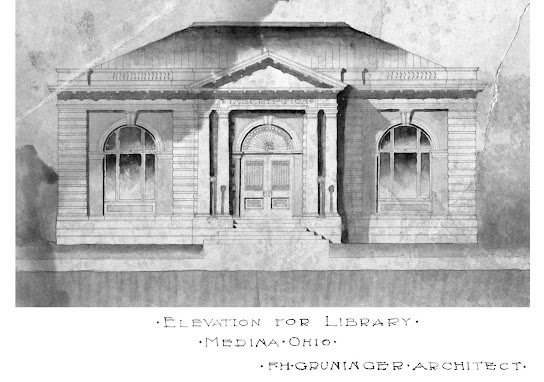
The Library Trustees then hired Lee Fretz to be the contractor and Frank Gruninger as the architect.


According to an article from the Medina Gazette, 15 June 1906, the trustees were not sure how to place the building. The majority wanted it to face the corner of the lot so it would be facing both Broadway and Washington. Yet, I think the contractor and architect had a different opinion because the finished building faced Broadway. 

Plans were drawn up and submitted to the trustees.


And by the end of June of 1906…the building began….
 
Medina Gazette, 29 June 1906


How happy Mr. Sylvester must have been to see the progress made on the building that he made possible with his generous donation. Sadly, he would not see it completed. On May 24, 1907 the Medina Gazette wrote he was seriously ill and on May 31st he passed away. 


However, even in death, Mr. Sylvester continued to support the library. He left the library an additional $4,000 in his will. 


Three months later, the Library's Board of Trustees met for the last time in the old library building on East Liberty. 


On September 29, 1907…a rainy and cold day…the library was dedicated to the people of Medina.


Medina Gazette


Medina Gazette, 4 Oct 1907

The town of Medina grew and changed through the years. However, in 1938, the library still looked pretty much the same. The front was covered with ivy but the interior still looked like the description in the above 1907 article.


                                                                                                                                                                  Medina continued to grow and in 1976 an addition was put on the original building. 


                                                                                                                                                                     In 2008, another addition was added to the building, along with a complete renovation inside. 

Due to a another generous donation, this time from Virginia Wheeler Martin, a former Medina resident, the library was able to open the Virginia Wheeler Martin Family History & Learning Center in 2019. 

Thank you Mr. Franklin Sylvester for having the foresight to see what an important part of this community our library would become. We hope you would approve of the many ways it has grown and how it benefits not only our city, but our county as well.  


To learn more about Franklin Sylvester click on this link: http://mcdlgenealogyspot.blogspot.com/2016/10/franklin-sylvester.html


Sources:

"Ohio, U.S., Wills and Probate Records, 1786-1998," digital images, AncestryLibraryEdition (accessed through participating library: accessed 13 September 2021); citing Otis Thompson, Wills, Probate Court, vol. K, 1897-1899, p. 365-55, Medina, Ohio.

"Ohio, U.S., Wills and Probate Records, 1786-1998," digital images, AncestryLibraryEdition (accessed through participating library: accessed 13 September 2021); citing Franklin Sylvester, Wills, Probate Court, Vol. P, 1906-1908, p. 365, Medina, Ohio. 

Medina Library Board of Trustees, Minutes, 13 September 1907, Medina Library, Ohio.

Joann King, "The History of Medina's Kings-Phillips-Deibel House," Medina County Gazette, 6 June 2006; Historical Homes of Medina, v. 2, H-L, Medina Library, Ohio. 


Medina County Gazette, 20 April 1898, p. 4
Medina County Gazette, 21 October 1904, p. 1
Medina County Gazette, 6 January 1905 p. 1
Medina  County Gazette, 24 February 1905, p. 1
Medina County Gazette, 15 June 1906, p. 1
Medina County Gazette, 29 June 1906, p 5
Medina County Gazette, 7 June 1907, p. 5


Sunday, August 29, 2021

Genealogy Discussion Group


The Genealogy Team is delighted to launch a monthly genealogy discussion group at noon on the 2nd Wednesday of each month.
 
Starting August 11th in meeting room 2A on the second floor of the Medina Library, The Genealogy Team, Lauren Kuntzman, Kathy Petras, and Lisa Rienerth, will be available to discuss research, share hints, and ask questions. Crow about your latest success story or we can share feedback on your stalled research. 

Can't make it on the 11th?

The discussion group will also be held noon on:
  • 8 Sep
  • 13 Oct
  • 10 Nov
  • 8 Dec
  • 12 Jan 2022
  • 9 Feb
  • 9 Mar
  • 13 April
  • 11 May
Connect with fellow genealogists. Learn from other's experience and mistakes. All are welcome!


Meeting room 2A and 2B on the 2nd floor of the Medina Library next to the Reference Desk.


Must Love Cemeteries...

How to be a Findagrave™ Volunteer


The warm weather is upon us and some of us like to enjoy it by walking through cemeteries. It is always beautiful and it can be very interesting and informative. If you are one of these people, then consider volunteering with Findagrave - many historians and family researchers would be grateful! 

The gravesites on this site are listed as Memorials and with those memorials are sometimes a photograph of the gravestone. This helps a researcher in two ways. First, the memorial has information on the person who is buried at the gravesite, such as birth and death dates. Second, if the photograph is also available it helps those researchers who cannot visit the cemetery in person either because of the distance or mobility issues. 

It is the memorials without photographs that need someone to take a photograph of the gravesite and upload it to the site. 


Interested? Here's how to help....

The first step is to register with Findagrave at findgrave.com. 


After clicking on "REGISTER", fill out the form and don't forget to check the box to become a photo volunteer!  You can click on "What is a Photo Volunteer" for a more in depth description.                        You will use this email and password to SIGN IN to the site. 


After signing in you can find out who is requesting a photograph by clicking on the camera icon on the home page.


This will take you to the request page. Click on the "Open Requests" tab and filter the search to either your home location or a different location and how many miles you are willing to travel.  A list of request will be generated.


It will show which requests have been claimed and which ones are still open. To claim it, click on the CLAIM button and start searching.  Be aware that if the flag to the left of the CLAIM button is red, this means someone has already searched for this gravesite and there was a problem with it. Click on the flag to see the problem. 


Once you have taken the photo you will come back to the request page and click on the FULFILL button. This will take you to the upload page.

Don't forget to read the photo guidelines. 


The person who requested this photograph will be notified by email that the photograph is now uploaded to their ancestor's Memorial Page.


 If you want to search for your relative's Memorial page use the search box on the home page. This will give a list of names to click on to navigate you to their memorial page. 


If your ancestor does not have a photograph of the tombstone on their memorial page, you would just click on the Request  Photo icon and it will be placed on a list for the volunteers in that area.
To upload your own photographs to the memorial it is as simples as clicking on the Add Photo icon and uploading it the same way you would when fulfilling a request. 


If yours search comes up empty you can also create a Memorial Page for your relative as long as you know where this person is buried.   First, you click on the Add a Memorial icon found on the Home Page.   


Find the cemetery's listing...


Then fill out the form and click on ADD MEMORIAL at the bottom of the page.


Once the memorial is created you can either upload your own photograph or request it to be filled. 


Findagrave also has a wonderful selection of video tutorials that help walk you through this and many of the other options available on the site. Just look for the tutorial icon at the bottom of the screen. 


Volunteering for Findagrave is both easy and gratifying. There are a few more sites which benefit from the help of volunteers, such as Billongraves and Ohio Gravestones. If you have the time and love visiting cemeteries, please consider helping those in search of their ancestors. 

You might also want to read our blogs on Research Trips and Cemetery Research before heading out to the cemetery! 


Thank you to Findagrave for allowing us to use images from the website. 


Happy Anniversary Girl Scouts!

 March marks the 109th anniversary of the Girl Scouts.  


In 1912, when U.S. women still did not have the right to vote, Juliet Gordon Low wanted young women to envision all the opportunities available to them. Emphasizing inclusiveness, the outdoors and self reliance, Juliette's girls: 

●  Hiked 

● Camped

● Swam 

● Played basketball 

● Learned to tell time by the stars 

● Studied foreign languages 

● Shared a sense of adventure & belief that they could do anything 

●Offered a helping hand to those in need 

●Made their corner of the world better

Low pinning a badge on a Girl Scout's uniform.
Circa 1912.


Still flourishing today, the Girl Scouts boast over 2.5 million members and over 50 million alums in 92 countries .


Girl Scout troops in Medina County are part of a regional group that has undergone many name changes. First they were called the Akron Area Scouts. Then they became the Summit City Council of the Girl Scouts. Then in 1962 they became the Western Reserve Girl Scout Council. Finally, in 2007 five regional Girl Scout Groups combined to become the Girl Scouts of Northeast Ohio.


Here's some highlights from the last 100 years of Girl Scouts in Medina County with emphasis on the early years of their development.

  • Miss Francelia Stuenckle
    German and Normal School Teacher*
    at the Medina High School.
    1917 -The first troop formed in Medina County was at the Medina High School in the fall of 1917. The United States had just entered World War I. Over 20 girls, all members of the junior class, attended the first meeting held at the Garfield Building (then the high school) in October. Miss Francelia Stuenckle was their scout master.
  • 1918 - The girls are avid hikers, trekking out to L.H. Randall's cabin and later to the Northern Ohio railway.
    • The sell tickets for the Red Cross Pageant, a fundraiser for WWI.
    • The Girl Scouts sell over $1600 War Savings Stamps^ That would be $28,000 in today's dollars. They do so well that the Boy Scouts back off from participating in the program.
    • The Girls jump into selling Thrift Stamps^
    • Miss Stuenckle returns to her hometown of Chicago and Miss Marion Whipple takes over the scouts.
  • 1919 - The Girl Scout presence in Medina County grows as Granger High School and Wadsworth form their own troops.
    • 19 girls attend camp for 10 days at Camp Mittawanda on Lake Erie. Several sets of parents visit their daughters at the camp.
    • In May, the Girl Scouts bring a group of Swiss Bell Ringers to Medina.
    • In December, they have a Christmas Party and later distribute Christmas baskets to the needy.
  • 1920 - The Girl Scout program expands into China, Syria and Mexico. In the U.S., Native American and Mexican American troops form. The Medina Troop spend 2 weeks at Chippewa Lake.
  • 1922 - The Lodi Girl Scouts spend a week at Camp Crag.
Started as a 4-H camp, Camp Crag welcomed many
Scout troops over the years.


  • By 1924, The Girl Scouts in the region had grown to over 20 troops with 700 members
  • 1925 - Sharon Township and Seville Girl Scout troops form.
  • 1930 - Girl Scouts collect food and clothing for those suffering the effects of the Great Depression.
  • 1932 - Camp Ledgewood opened up in Peninsula, OH

Camp Ledgewood is still used by Girl Scouts today.

  • 1936 - Two troops traveled to Camp Ledgewood.
    • The first "colored" troop forms in Medina. They are supervised by Mrs. Will (Sally) Ozier, who is also African American. Her husband supervised the Boy Scout "colored" troop.
    • The village of Medina has three troops of Girl Scouts.
  • 1937 - Disparities are seen; the "colored" troop were getting badges as "laundress", "housekeeper" and "needlewoman", while the other troops are receiving badges in "scholarship", "observer", "swimmer", "gardener", "child nurse" and "artist".
    • All 3 Medina troops attend Camp Crag
    • Medina Girls are getting the highest award. "Golden Eglet" status is awarded to Miss Mary Louise Long and Miss Ramona Everhardt.
  • In 1938, Troop 3, the "colored" troop is recognized by the Girl Scout National Headquarters.
  • 1939 - In the photo below, the girl in the second row, far right is Virginia Wheeler (Martin), who donated the money for the Medina Library Family History and Learning Center that bears her name. 
Oct 24, 1939  Medina Gazette p. 3


Virginia Wheeler's Girl Scout Badges:
Bird Watcher and First Aid
From the collection of Virginia Wheeler Martin.

Girl Scout image from circa 1940.
From the collection of Virginia Wheeler Martin.


Virginia Wheeler's Girl Scout Handbook
for the Intermediate Program, circa 1940
From the Collection of Virginia Wheeler Martin


  • 1940's - Nationally, Girl Scouts  supported the war efforts by operating bicycle courier services, running Farm Aide projects, and along with millions of other Americans, collecting fat and scrap metals and growing Victory Gardens. Internment camps in California and Utah saw the emergence of Girl scout troops among the imprisoned Japanese American girls.

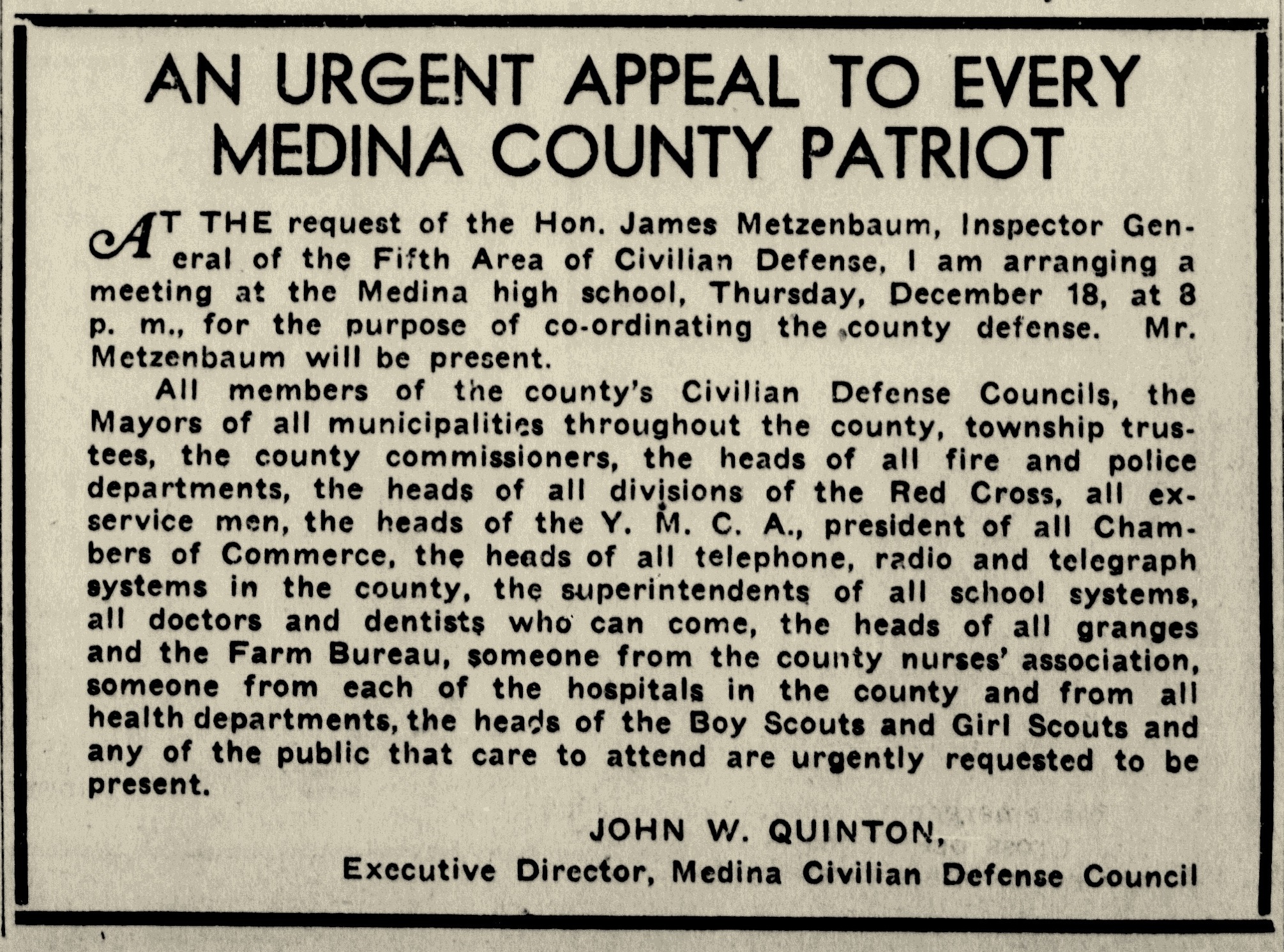
February 9, 1940 Medina Gazette Page 4.
An appeal goes out to area agencies to plan for Civilian Defense.
    • Locally, Medina Girl Scouts sold movie tickets in support of war relief.
    • The decade saw many of the troops selling Girl Scout cookies for the first time.
  • 1950's Girl Scouts assembled "Kits for Korea" to distribute items desperately needed by Korean citizens.
  • 1953 - Celebrating the 41st Anniversary of Girl Scouts
To celebrate the 41st anniversary of the founding of the 
Girl Scouts, the girls baked a cake and presented it to 
the superintendent of the Pythian Sisters Home.
March 17, 1953 Medina Gazette,  p. 1.

  • 1968 - Girl Scouts volunteer at the hospital along side Candy Stripers.
  • 1969 - Brunswick Senior Girl Scouts attend a national meeting at Kent State University where the following topics were discussed:
    • Learning to communication with other people
    • The War in Vietnam
    • Civil Rioting in the U.S. 
    • The males' view of sex, dating & marriage
  • 1969 in October the girls participated in a Dolly Derby, where they dressed the dolls and competed for best dressed. Later the dolls were given to Good Will to be sold in time for Christmas.

Green Leaf Park courtesy of Google Maps


  • 1972 - Local Girl Scout troops plant over 600 trees at the Sharon Gravel Pit Park. The park has since been renamed Green Leaf park. Today, you can't tell that it was once a gravel pit.


  • 1980's - They created the "Contemporary Issues" series  that addressed serious issues such as drug use, child abuse and teen pregnancy.


  • 1989 - Lodi Girl Scouts learn all the tricks of the trade in being a clown.
 February 27,  1989  Review Chronicle Page 10 


  • 1996 - The Girl Scout web site debuted and a Technology Badge was introduced.
  • 2000's focused on the healthy development of girls.
  • 2017 -  Girl Scouts help with the Children's Garden at Heritage Farm in Brunswick. 
    Girl Scouts Morgan Kulka and Lydia Miller work
     on the children’s gardens at Heritage Farm
    in Brunswick. (Photo Courtesy of Scott Miller)
    Cleveland.com

  • Natalie Bair
    Fox News

    2018-2019 - Medina Girl Scouts urge Medina City Council to ban plastic bags.
  • 2020 - 12 year old Natalie Bair received the Girl Scout Medal of Honor for saving her baby brother's life when he choked on a cracker while riding in the car.
  • 2021 - "Made with Code" program encouraged girls to work in computer science. Girl Scout cookies were sold online with "Digital Cookie"


Girl Scout COOKIES

In 1917, Girl Scouts in Oklahoma were baked the cookies themselves and sold them as a fund raisers. In 1922, a simple sugar recipe was shared in the Chicago Council. For years the girls baked and sold the cookies in simple wax paper wrapping.   The price? 25¢

A box of commercially baked Girl Scout Cookies from the 1930's

During World War II, sugar, flour and butter were rationed and in short supply. In 1944, the girls switched to selling calendars as an alternative.

After the war, cookie sales increased and by 1948, 29 commercial bakers were licensed to bake Girl Scout Cookies.

By 1951, the cookies came in 3 varieties; Sandwich, Shortbread with the famous trefoil imprint and Mints. By the 60's the bakers were wrapping the cookie boxes in aluminum foil or cellophane to preserve the cookies' freshness.

The cookie flavors have continually expanded and they now offer 12 varieties, including Trevoil/Shortbread, Thin Mints, Peanut Butter Sandwich and Samoas.

Which is your favorite? And how many did you order this year?


*"Normal School" was a teacher preparation course.
^Both the War Savings Stamps and Thrift Stamps programs were U.S. government projects to help fund the country's participation in World War I.

Medina County History Resource Now Available Online!

Medina County District Library is excited to announce that their local history collection "Medina Landmarks / About the Past" has ...