Showing posts with label genealogy. Show all posts

Thursday, June 16, 2022

JUNETEENTH

 June 19

by
Lauren Kuntzman
and 
Kathy Petras

Juneteenth Flag
The white star stands for Texas. The curved arc represents a new horizon 
Wiki Commons, 
https://commons.wikimedia.org/w/index.php?

June 19th, 1865, in Galveston, Texas, Union General Gordon Granger proclaimed  that "The people of Texas are informed that in accordance with a Proclamation from the Executive of the United States, all slaves are free." 

From Whitehouse.gov


The "Executive" was Abraham Lincoln who had died April 15, 1865 from an assassin's bullet. The "Proclamation" was the Emancipation Proclamation that had freed all slaves in Confederate Territory on January 1, 1863. 


However, the proclamation was hard to implement in states that were still under Confederate control. Only as Union troops moved into Confederate territory were they able to enforce the proclamation. And even though the Robert E. Lee had surrendered on April 9, 1865, Confederate troops held out in many places for weeks after. As the furthest west Confederate state, Texas was late to come under Union control.

Celebrating Granger's proclamation was immediate in Texas with feasting, song, dance and prayer. One year later, the first "official" Juneteenth took place. "Juneteenth" being a blending of "June" and "nineteenth".

Over decades the celebration spread throughout the country, each community developing its own tradition.

In 1980, Texas made it a state holiday, followed by Florida in 1991, Oklahoma in 1994, and Minnesota in 1996. Other states followed suit. Ohio proclaimed it in 2006. 

States that adopted Juneteenth as a holiday prior to the 2021 Federal recognition.
Red states recognized it before 2000. Yellow States recognized between 2000 and 2009. 
Blue states recognized between 2010 and 2021.
South Dakota (in grey above) did not codify the celebration until 2022.
Wikipedia


And in 2021, the U.S. Senate unanimously passed an act making it a National Holiday. 


And on June 19, 2022 Medina will officially celebrate Juneteenth for the first time.

And following the traditions from the first Juneteenth, the day will start with a church service, followed by speakers, including Danita Harris from WEWS, vendor tables, food trucks featuring soul food and traditional Southern cooking, African drummers and the Mojuba! Dance Collective from Cleveland.

Join your neighbors and friends in celebrating this landmark day!


In honor of Juneteenth, here are 5 resources to help you research African American ancestry: 

1. African American Heritage
Search historical records specific to African Americans to trace your genealogy or to do research. Visit https://mcdl.info/OnlineLearning and access with your library card.

2. Ancestry - Freedmen's Bureau Records
Search 3.5 million records from 1846-1874 to learn about previously enslaved people moving from slavery to citizenship and freedom. Free access to Ancestry at MCDL branches.

3. Black Freedom Struggle in the United States
Explore newspaper articles, diaries, correspondence and more, from periods in U.S. history marked by the opposition African Americans have faced on the road to freedom. Access at https://blackfreedom.proquest.com.

4. Born in Slavery: Slave Narratives from the Federal Writers' Project, 1936 to 1938
Explore 2,300 first-person accounts of slavery and 500 black-and-white photographs of former slaves. Access at https://www.loc.gov/collections/slave-narratives-from-the-federal-writers-project-1936-to-1938/about-this-collection.

5. Last Seen: Finding Family After Slavery
Search 2,500+ newspaper ads by formerly enslaved people seeking information on loved ones after emancipation. Includes 275 U.S. newspapers, published between 1865 and 1920. Access at https://informationwanted.org.


Sources:


Thursday, June 9, 2022

Military Records at Fold3


by
Kathy Petras

Fold3 is a database available either with a subscription or through your local Medina County District Library. 

It provides access to U.S. military records, including the stories, photos, and personal documents of the men and women who have served in wars and conflicts since the Revolutionary War.

In 2007, when it was first created it was called Footnote and contained over 5 million records.

In 2010, Ancestry.com bought the database and it was renamed Fold3. Fold3 comes from the traditional flag folding ceremony in which the third fold is made in honor and remembrance of veterans who served in the U.S. military. 

Fold3 Library Edition is available in most Ohio public libraries. From the Medina Library site, mcdl.info, go to the Research & Learning tab and click on "F" from the alphabet list. Fold3 is the third item down.

It's a useful tool for all types of researchers:

  • Historians
  • Genealogists
  • Teachers
  • Veterans and their families.
  • Genealogical Societies
While its focus and strength has always been U.S. military service people, it also covers records from the U.K., Canada, Australia and New Zealand.

The landing page has a simple search box with links to the records from different countries below it.

Beneath that are links to the most popular record groups and Featured Memorials for a few of the veterans on the site.


 The menu bar at the top of the page gives you several options.


The "HOME" button will always take you back to the Home Page, and the "SEARCH" button will always take you to the Search Box. 

"BROWSE" lets you browse the collections by:
  • Conflict
  • Title of the database set
  • Place
  • Publication Type
  • Content Provider 
  • Branch of Service
"WAR STORIES" provide insight to the events of the conflict. You can narrow it down by conflict, country and keyword. Since it is a new feature, they are looking for feedback.

"MEMORIALS" are dedicated to specific individuals. Anyone that Fold3 can identify has a Memorial created by the Fold3 team. But you can create Memorials to any of your ancestors. You will need to create a "MEMBER LOGIN" for that function. You can add stories, pictures and documents. 

Memorials I've created for just a few of my ancestors with military experience. I've included
photos, stories, records and even maps to help tell their stories.


The "HELP" tab lands you on Fold3's Training Center with videos explaining all of the sites many functions. I highly recommend you spend some time there. 

The easiest way to search an individual is to type a veteran's name into the search box. If it is a very common name, add the person's birth year to narrow down the search results. 


The search results page displays the most likely search results and how many results were found. On the left, a list of filters helps to narrow down your search results. 

With such a common name as Donald W. Johnson, this relative's military service nearly escaped my attention. Nothing I knew about him suggested he had served. His draft registration card even indicated he had "a short right leg" which would have disqualified him for military service. 


This "Application for Headstone or Marker" proves that he did serve. He was part of the Army's 1560th SCU. SCU stands for Service Command Unit. The 1560th was stationed at Camp Atterbury in Indiana as a Special Training Unit. They trained recruits in academic as well as military subjects that better prepared them for service elsewhere. 

The database has numerous tools to help you modify or use images of the records you find. The most important one is the Tools icon that appears above and to the right of the image.

It allows you to download or print the image, add it to an Memorial or share it via Facebook or Twitter.

Explore all these tools as you research your ancestors and relatives with military service in their background. Or honor your ancestor by creating a Memorial.

Thursday, March 31, 2022

Meroa Andrews - Remarkable Woman


by Kathy Petras


In many ways, Meroa ANDREWS was a typical 19th century Victorian woman. (No photograph has been found of her.)

And as often was the case in this time period, she was often defined by her relationship to others. 


She was the daughter of Sheriff Morgan Andrews. 

She was the sister to Civil War soldiers, Addison and Morgan Andrews and also to the Girard, Pennsylvania bank president, Fairman Andrews. 

She was an employee of A.I. Root.


She WAS all those things. But she was also much more.


She was:

  • A teacher
  • An inventor
  • An entrepreneur
  • A Librarian
Some amazing accomplishments for a Victorian era lady. 

Let's take a closer look at the life of this remarkable woman.

Meroa was born in 1838 in Schoharie County, New York. She was the fourth child of Morgan ANDREWS (1816-1867) and Esther LEVALLEY (1809-1846):
  • Sarah L. ANDREWS (1830-1910) BROOKS
  • Addison P. ANDREWS (1833-1896)
  • Fairman ANDREWS ( 1835-1910)
  • Meroa ANDREWS (1838-1910)
  • Morgan ANDREWS ( 1843-1862)
In the mid 1840's the family moved to Hinckley Township, Medina County Ohio. Shortly after that, in November 1846, Esther died. With small children in the household, Morgan quickly remarried to Cordelia BROOKS (1828-1908) in October of 1847. Cordelia was only 2 years older than Sarah, Morgan's oldest daughter.

1857 Plat Map of Medina County Ohio from the Library of 
Congress. This excerpt is from the northwest corner of 
Hinckley Township.

In the 1850 Census, the ANDREWS family is enumerated in Hinckley Township. Morgan's occupation is "tailor".

In that same year, Morgan buys his first property in Medina County, a 1 acre plot.

Sarah ANDREWS married Ransom BROOKS in 1852. Ransom (aka "Doctor") was Sarah's step-mother's older brother!

Two more children were added to the family with the birth of Meroa's half-brothers, Finley in 1855 and Charles in 1863.

The family's residence and fortunes were about to change. In 1858, Morgan was elected as Medina County's Sheriff and they moved to Medina Village. How do you go from being a tailor to being the county sheriff?

The 1860 Census of Medina lists Morgan as the county sheriff and Meroa (listed as Maria) is a "C S Teacher" There are two non-family members listed in the household. Christopher Breeman is a farmer who is listed as "insane" and John Reed is a convict. Unfathomable  to modern minds that the sheriff would house  these men in his home with his family. Both were probably awaiting transportation to more permanent facilities. 

1860 Census for the Village of Medina, Medina County, Ohio.

While Meroa's occupation may look like "C P Teacher", if you compare the second letter to how "Sheriff" is written two lines above Meroa's listing it becomes obvious that it is "C S Teacher".  "C S" stood for common school, comparable to elementary schools today (For more on Medina City's schools see this blog from December 21 2021 Medina City Schools  We don't know which of Medina's three common schools Meroa taught at. 

We do know that it was far enough away from the Andrews home for her little brother Morgan to drive her during inclement weather. He mentions it three separate times in his diary during the early months of 1862. To find out more about Morgan Jr's diary view this blog from December 2018 Touching History.  These rides were probably a very poignant memory for Meroa. Morgan joined the Union Army and died in Cumberland, Maryland of disease in July 1862.

Sometime early in 1867, Morgan Sr. died and was buried in Bennetts Corner. His widow, Cordelia was relatively young at the age of 39 and had small children to raise. She remarried to George Houck in November of the same year.

Sometime during 1860-1870, possibly after her father's death, Meroa had a change of occupation. In the 1870 census, she is living in the household of a very prominent Medina business man:

1870 Census, Medina Village, Medina County, Ohio


Meroa is working in a "Rings & Chain Factory"  and living in the household of Amos Ives Root! They had a business relationship that spanned many years.

In 1872, Amos & wife Susan, named their third child Constance Meroa Root. AND A.I. and Meroa took out patent #128,072 for an improvement in bee hive frames in same year!

Patent 128,072 with Meroa's name right next to A.I. Root's


Front page of their accepted Patent application


For those of us who cannot read the design, the Medina Gazette published an article that describes how the improved frame works:

Medina Gazette 28 June 1872 p. 1

A few short years later, Meroa left the A.I. Root Company:

 Medina County Gazette June 18th, 1875, page 3.

Meroa kept busy.

When the Medina Circulating Library Society was formed in 1877, she was among the founding members, serving as the Librarian for nearly ten years (1882-1891) at a salary of $20 per year.  She housed the books in her jewelry store.

Then, she sold queen bees, advertising them in the early editions of A.I. Root's Gleanings in Bee Culture:

Gleanings in Bee Culture Vol 7 issue 6 June 1879 page 4.

In the same issue, A.I. was advertising that he would buy quality Italian queen bees.
The 1880 Census finds Meroa and her niece Carrie (brother Fairman's daughter) boarding in the home of Archibald Matteson, Life and Fire Insurance Agent (later the Ohio Farmers Insurance and currently Westfield Insurance).

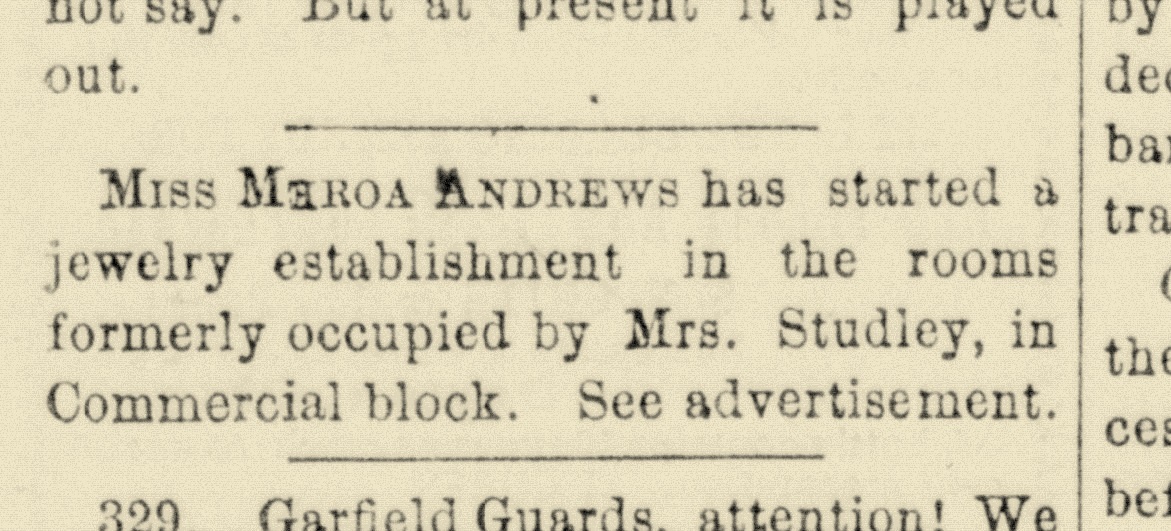
And in the 1880's these advertisements were in every edition of the Medina Gazette:


1880 Oct 15th Medina County Gazette  Page 7


1880 Oct 15th Medina County Gazette  Page 2


1881 Feb 18th Medina County Gazette Page 4


1883 May 4th Medina County Gazette  Page 4


Medina County Gazette March 23rd, 1883, page 8


Medina County Gazette November 18th, 1887, page 5
Besides serving as the Librarian, Meroa was also
the treasurer. 


When she wasn't busy inventing things or running a library and a jewelry store, or teaching the ladies of Medina how to knit lace, Meroa was busy visiting friends and relatives. Meroa's friends were the upper echelon of Medina society: Cora Munson, the McDowells, A.I. Root, and the Barnards.  Among the trips noted in The Gazette:
  • 1875 - After leaving the A.I. Root Company, Meroa visited her sister Sarah BROOKS in Mankato, Minnesota from May to September.
  • 1885 - Along with Sarah Smith she traveled to West Virginia to visit their friend Josephine Manning, who was dying.
  • 1893 - In June she visited her brother Fairman in Girard, Erie County, Pennsylvania. Fairman became the president of The National Bank in Girard.
  • 1898 - Meroa joined Cora MUNSON and Bertha BARNARD in an outing to Put-In-Bay. A good time was had by all.
  • 1899 - In September, Meroa's sister-in-law died in Pennsylvania and Meroa traveled to the funeral. When she returned, she brought her niece Carrie with her. She sold off her jewelry store stock, intending to move to Girard to live with her brother. Fairman arrived in October to bring Carrie back home. Meroa moved out of her Medina lodgings and visited with friends in Elyria and Berea before moving to Pennsylvania. In November she attended the Opera in Cleveland with Miss Cora Munson, Mrs. Chris Griesinger, Mr. & Mrs. B.L. Wells & Halcyon Wells. Finally she left for her "future home" with her brother.
  • 1900 - Meroa again "visited" her sister in Mankato and returned two years later in December 1902.
  • 1906 - In October, Meroa joined a "Trolley Party" from Medina to the Hotel Morton in Seville for some fine dining. The party included Mmes. R.M. & O.H. McDowell, H.G. Rowe, Blake McDowell, Bessie Hewes and Hattie Elder.
Meroa has not been found in the 1900 census. Theoretically, she should be living with her brother, Fairman, in Girard, but she isn't listed with him. She also isn't listed with her sister in Mankato, Minnesota. Neither is she in the Medina or Cuyahoga county censuses. The census was taken in the early part of June in 1900. 

Medina County Gazette, June 28th, 1900, page 3

This June 28th article indicates that Meroa did live with her brother for a short time, but returned to Ohio, settling in Berea. It was possible she was traveling at the time that the census was taken and she was missed completely. 

In 1903, at the age of 65, Meroa once again set up a business in Medina.

Medina County Gazette, May 22nd, 1903, page 3.


Once she returned to Medina, Meroa resided as a boarder in various homes:1903 - 
  • 1903 - In February she had rooms at S.G. Barnard's home 
  • 1904 - She moved into the L.S. Smith house
  • 1910 - On 15 April, the census counted Meroa among the household members of Alonzo Case, 412 Lafayette Rd. in Montville Township.
Finally, on May 2nd 1910, just  two weeks after the census was taken and after losing her sister Sarah and brother Fairman earlier in the year, Meroa died at the home of Clara Wheatley at 303 East Washington. The Wheatley home is just one block east of the Medina Library, whose genesis Meroa contributed to.

The end of the life of a Victorian Medina Lady who was so much more than what could be found in records.


Wednesday, February 2, 2022

Freedmen's Bureau Records


What was the Freedmen's Bureau?  

In 1865, the U.S. Congress passed “An Act to establish a Bureau for the Relief of Freedmen and Refugees” to provide food, shelter, clothing, medical services, and land to displaced Southerners, including newly freed African-Americans".   

Commonly called "The Freedmen's Bureau", it was created near the end of the Civil War to help previously enslaved people move from slavery to citizenship and freedom. During its existence it supported more than 4 million people, that included some poor white people & veterans of the U.S. Colored Troops. Due to political opposition, it ended abruptly in 1872. The Bureau encompassed 11 former rebel states plus Maryland, Kentucky, West Virginia and Washington, D.C.

Map courtesy of Ancestry.com

While parts of the Freedmen's Bureau records have been available on FamilySearch.org and Heritage Quest, now 3.5 million records have been digitized and INDEXED on Ancestry.com

Microfilm coverage of states where the Freedmen's Bureau was active.
Chart courtesy of Anestry.com


The above chart of microfilm of the Freedmen's Bureau Records illustrates that participation and coverage of the records is not evenly distributed throughout the effected areas.

For many of the descendants of the freed people, this is the earliest period for which they will find their ancestors' complete names in official documents.

And best of all, access to these records is FREE! at  www.ancestry.com/freedmens 

If you don't already have one, you will need to set up free account. 

Documents include:
  • Labor contracts between the freed people and new employers
  • Contains employment and pay registers 
  • Rations to the poor (white or black) 
  • Set up apprenticeships
  • Letters
  • Legalizing marriages entered into during slavery
  • Built hospitals& access those records
  • Pension records
  • Built thousands of schools, including Howard University in Washington, D.C. & includes school records
  • Tax assessments
  • Reunite previously enslaved people with family
  • Assist in relocating people to other parts of the country
  • Freedmen's Bank records
U.S., Freedmen’s Bureau Marriage Records, 1846-1867 for Julie Tagg
Freedmen´s Marriage Certificates, 1865-1869

This marriage document from Memphis, Tennessee reveals a goldmine of information on the couple:
  • It lists their names
  • The date of the marriage
  • Ages
  • Their color complexion
  • The color complexion of both sets of parents 
  • How many previous partners they have had.
  • What happened to that relationship - separated by force
  • How many children each of them are bringing into the marriage
This record predates the formation of the Freedmen's Bureau in 1865, but is included in those records.

Looking back four years to the 1860 Slave Schedule census for Ward 7 of Memphis Tennessee we find this listing for Joseph Tagg, my 4X great-uncle:
1860 Slave Schedule Census for the 7th Ward, Memphis, Shelby County, Tennessee.

It is very possible that the 30 year-old Julie Tagg from the marriage record is the same "28 year-old female slave" in Joseph Tagg's household. 

Information found in Freedmen's documents:
  • Name
  • Sex
  • Age
  • Race (including complexion)
  • Height
  • Residence
  • Occupation
  • Names of Family Members
  • Names of former enslavers/plantations
  • Names of employers
This listing in the index to the the Freedmen's Bank Records...


Led to this record:
This record lists Joseph FOGG's parents and brothers and sisters and Joseph's occupation
on the FamilySearch digitized microfilm. United States, Freedman's Bank Records,
1865-1874 Memphis, Tennessee Roll 24, Dec 28, 1865.

This register of signatures for depositor's is for Fannie ARTIS:

Listing her age, birthplace, residence, parents' and sisters' names, it also tells us
that her husband is deceased and he is not the father of her infant son.
Like many previously enslaved people, Fannie could not write her own name.

The database consists of three record sets. 
  1. Freedmen's Bureau Records, 1865-1878
  2. Freedmen's Bureau Marriage Records, 1846-1867
  3. Freedmen's Bureau Bank Records, 1865-1874
If you want to focus on records in one of the sets, from Ancestry's drop down menu choose "Catalog" and perform a keyword search on "Freedmens" and then choose which set you want to search.

Not sure if there was a Freedmen's Bureau office where your people of interest lived? Check out Mapping the Freedmen's Bureau.

"The Freedmens Bureau" by A. R.Waud
Man representing the Freedman's Bureau stands between
armed groups of Euro-Americans and Afro-Americans.
Originally published in 
Harper's Weekly, July 25, 1868.
From the Library of Congress

The Bureau faced stiff political opposition from President Andrew Johnson (1865-1869) and white Southerners and was eventually closed down in 1872 without completing its missions.

Ultimately, its biggest success was introducing the Federal Government into issues such as social welfare and labor relations.

If you would like to learn more about this African-American resource and many others, please sign up for the virtual class presented by renowned scholar, Ari Wilkins, for Beginning African American Genealogy on February 28.  

OTHER UPCOMING EVENTS:
  • Genealogy Discussion Group - Noon on February 9 - Join the Genealogy Team staff as all things genealogy is discussed. No registration required.
  • The Underground Railroad - The Medina County Historical Society will be hosting an event on February 26th from 1-2 p.m. at the Medina Library on the Underground Railroad in Medina, covering stations on the trail, local abolitionists, and the African Americans in Medina County. Contact the Historical Society with any questions: mchs@zoominternet.net

SOURCES:

Monday, December 20, 2021

Beginner's Kit & Basic Genealogy DNA Class

  by Kathy Petras

New incarnation of the Family History Guide

Introduction to Family History: a guide for beginners

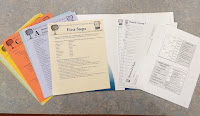
The Beginner's Genealogy Kit provided to novice family historians by the Library has undergone a transformation. Restyled as an Introduction to Family History: a guide for beginners, it has a more polished look and is now a booklet. The previous kit was a collection of handouts inserted into a folder.  
Previous Beginner's Kit


The new Guide covers the six major steps of beginning family history research:
  1. Getting Started - with whom do you start?
  2. Searching Your Home - what you already know.
  3. Write Down What You Find - forms, formats and documenting what you find.
  4. Interview Your Relatives - getting the most from their knowledge.
  5. U.S. Census Records - documents where your ancestors lived and when they were there. Contains clues as to where to look for other documents.
  6. Search for Vital Records - official documentation of the most important or "vital" events in everyone's life.
The Guide also contains many tips for organizing your records and covers special topics such as DNA Testing. 

Stop by the service desk in the Virginia Wheeler Martin Family History & Learning Center on the second floor of the Medina Library to pick up a copy or access it online at: Introduction to Family History: a guide for beginners

Considering DNA Testing for Genealogy?


With the holidays, most of the leading genealogy DNA testing companies have their kits on sale. Before you splurge for the cost of one, for yourself or as a gift, make sure you are aware of possible consequences.
On December 1st, the Library is offering a one-hour class on the basics of genealogical DNA testing, the types of tests, and a comparison of the five major testing companies: 23 and Me, Ancestry DNA, FamilyTree DNA, Living DNA and MyHeritage DNA.
Most people don't put much thought into testing before they swab their cheeks. This class urges you to think before you buy.
The class is from 6:30-7:30 p.m. 
Sign up HERE.

THE BLOG IS TAKING A SABBATICAL NEXT WEEK FOR THANKSGIVING DAY

IT WILL RETURN ON DECEMBER 1ST.


Medina County History Resource Now Available Online!

Medina County District Library is excited to announce that their local history collection "Medina Landmarks / About the Past" has ...