Showing posts with label lauren kuntzman. Show all posts

Thursday, January 12, 2023

Researching Property in Medina County Part 1

 Using the Medina County Auditor's Website

-Lisa Rienerth

         www.medinacountyauditor.org


Click on the Youtube link to view the video on how to use the Medina County Auditor's website for property research.  

 https://youtu.be/XhfbPQpi09o

Wednesday, November 16, 2022

How Comedy Sold WWII War Bonds

Abbott & Costello Go to Medina                     

-Lisa Rienerth

Medina County Gazette, 18 July 1942, p. 1


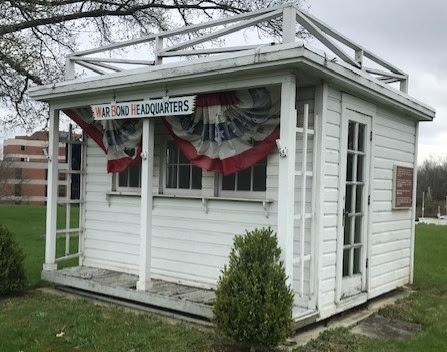
It began when a group of volunteers built a small, white building to sell War Bonds, stamps and corsages here in Medina, Ohio. 

Medina Sentinel, 23 July 1942, p. 1
The completed building was placed on the west side of  Medina Square and a grand opening was held the 18th of July 1942.


The building would not have been built without the generosity of the local businesses.  


The opening program lasted a little more than 3 hours with speeches from Amherst Spitzer, the War Bond chairman, music by the Akron Defense Council band and a few short speeches by a few local veterans. 


On that first day, $1,900 in bonds were sold, along with $97 in stamps and $95 in "stamp corsages". Stamp corsages are exactly what they sound like, corsages made with saving stamps. 

One Month Later....

The Treasury Department of Cleveland saw that Medina County was one of the top sellers of War Bond funds and rewarded the county with a special visit from "The biggest singular attraction of Medina County...". 

On August 19, 1942, Bud Abbot and Lou Costello, a famous comedy duo of the time, were coming to Medina to help sell War Bonds! 

Abbott and Costello were known in the 1940's as the "Leading Laugh Team".  They worked in radio & film and became even more popular during the World War II era.

This must have been one of the most exciting things to happen to the area in years, because the Medina Gazette was estimating a crowd of 10,000 people. 


Medina Sentinel, 13 August 1942, p. 1


Plans were made to build a platform and wire the Medina Square with loudspeakers. The organizers of the event wanted to make sure the duo was seen and heard by all. War Bonds were to be sold just outside the beautiful, new War Bond building. 

There was also a contest between the townships to see who could sell the most War Bonds before the big day arrived. 

Medina County Gazette, 21 August 1942, p 1
The night of the program a large crowd filled the square. 

Abbott & Costello arrived at 7:40 p.m. and according to the papers "Pulled several spontaneous laugh provoking remarks..." and autographed the bonds that they sold that evening. 

Liverpool Township won the Bond contest by collecting $21,835 in War Bond sales. 

George Wolfe, chairman of the Liverpool township war bond drive committee, was congratulated by Amherst Spitzer and the two comedians

The evening was a great success. $8,000 in bonds were sold at the War Bonds building. The total amount collected by all of the townships for the contest was $225,291, which is equivalent to just a little more than (4) four million dollars today.

The county continued to raise large amounts of money throughout the war. According to Robert Hyde's Beyond the Storefronts, "This is the famous [War Bond] building that at one point raised over 3 million dollars towards the war effort and was also part of the reason why the government decided to film "Hometown U. S. A.”  in Medina.*

*This link will take you to a past blog on the film.


And here's the rest of the story...

After World War II, the small, white building was put into storage and then moved to the property owned by Dr. Frederick Fri, who served in the war. Dr. Fri's property was acquired by the Medina General Hospital and the building was left on the land.

In 2001, the Medina Jaycees refurbished the building. Elmer Zarney, who created the original sign, remade a new sign, because the old one was lost. Zarney was a fighter pilot in World War II. 


Medina County Gazette, 8 Nov 2001
      
The building stayed on the Medina Hospital, n.k.a. Medina Cleveland Clinic, property until this November. The Medina County Historical Society took an interest in it and on the fourth had it moved to the property of the McDowell-Phillips Home, which is also owned by the society.  

Historical Society's President, Brian Feron, says the building will be restored and used as a place to display local historical items. It will then be used for educational purposes and someday a "Victory Garden" may be planted alongside it.


This little, white building witnessed Medina's history for the past 80 years. Now, because of the Medina County Historical Society, it can not only be a witness to many more years, but will teach other generations about the history of the county and its contribution and dedication to our nation at a time of war. 

Please leave a comment if you were a witness to this spectacular night in Medina. We would love to hear about your experience! 

Learn more about World War II War Bonds from Abbott & Costello by watching a Public Service Announcement from that era by clicking on the highlighted link. 


Thursday, June 16, 2022

JUNETEENTH

 June 19

by
Lauren Kuntzman
and 
Kathy Petras

Juneteenth Flag
The white star stands for Texas. The curved arc represents a new horizon 
Wiki Commons, 
https://commons.wikimedia.org/w/index.php?

June 19th, 1865, in Galveston, Texas, Union General Gordon Granger proclaimed  that "The people of Texas are informed that in accordance with a Proclamation from the Executive of the United States, all slaves are free." 

From Whitehouse.gov


The "Executive" was Abraham Lincoln who had died April 15, 1865 from an assassin's bullet. The "Proclamation" was the Emancipation Proclamation that had freed all slaves in Confederate Territory on January 1, 1863. 


However, the proclamation was hard to implement in states that were still under Confederate control. Only as Union troops moved into Confederate territory were they able to enforce the proclamation. And even though the Robert E. Lee had surrendered on April 9, 1865, Confederate troops held out in many places for weeks after. As the furthest west Confederate state, Texas was late to come under Union control.

Celebrating Granger's proclamation was immediate in Texas with feasting, song, dance and prayer. One year later, the first "official" Juneteenth took place. "Juneteenth" being a blending of "June" and "nineteenth".

Over decades the celebration spread throughout the country, each community developing its own tradition.

In 1980, Texas made it a state holiday, followed by Florida in 1991, Oklahoma in 1994, and Minnesota in 1996. Other states followed suit. Ohio proclaimed it in 2006. 

States that adopted Juneteenth as a holiday prior to the 2021 Federal recognition.
Red states recognized it before 2000. Yellow States recognized between 2000 and 2009. 
Blue states recognized between 2010 and 2021.
South Dakota (in grey above) did not codify the celebration until 2022.
Wikipedia


And in 2021, the U.S. Senate unanimously passed an act making it a National Holiday. 


And on June 19, 2022 Medina will officially celebrate Juneteenth for the first time.

And following the traditions from the first Juneteenth, the day will start with a church service, followed by speakers, including Danita Harris from WEWS, vendor tables, food trucks featuring soul food and traditional Southern cooking, African drummers and the Mojuba! Dance Collective from Cleveland.

Join your neighbors and friends in celebrating this landmark day!


In honor of Juneteenth, here are 5 resources to help you research African American ancestry: 

1. African American Heritage
Search historical records specific to African Americans to trace your genealogy or to do research. Visit https://mcdl.info/OnlineLearning and access with your library card.

2. Ancestry - Freedmen's Bureau Records
Search 3.5 million records from 1846-1874 to learn about previously enslaved people moving from slavery to citizenship and freedom. Free access to Ancestry at MCDL branches.

3. Black Freedom Struggle in the United States
Explore newspaper articles, diaries, correspondence and more, from periods in U.S. history marked by the opposition African Americans have faced on the road to freedom. Access at https://blackfreedom.proquest.com.

4. Born in Slavery: Slave Narratives from the Federal Writers' Project, 1936 to 1938
Explore 2,300 first-person accounts of slavery and 500 black-and-white photographs of former slaves. Access at https://www.loc.gov/collections/slave-narratives-from-the-federal-writers-project-1936-to-1938/about-this-collection.

5. Last Seen: Finding Family After Slavery
Search 2,500+ newspaper ads by formerly enslaved people seeking information on loved ones after emancipation. Includes 275 U.S. newspapers, published between 1865 and 1920. Access at https://informationwanted.org.


Sources:


Thursday, June 9, 2022

Military Records at Fold3


by
Kathy Petras

Fold3 is a database available either with a subscription or through your local Medina County District Library. 

It provides access to U.S. military records, including the stories, photos, and personal documents of the men and women who have served in wars and conflicts since the Revolutionary War.

In 2007, when it was first created it was called Footnote and contained over 5 million records.

In 2010, Ancestry.com bought the database and it was renamed Fold3. Fold3 comes from the traditional flag folding ceremony in which the third fold is made in honor and remembrance of veterans who served in the U.S. military. 

Fold3 Library Edition is available in most Ohio public libraries. From the Medina Library site, mcdl.info, go to the Research & Learning tab and click on "F" from the alphabet list. Fold3 is the third item down.

It's a useful tool for all types of researchers:

  • Historians
  • Genealogists
  • Teachers
  • Veterans and their families.
  • Genealogical Societies
While its focus and strength has always been U.S. military service people, it also covers records from the U.K., Canada, Australia and New Zealand.

The landing page has a simple search box with links to the records from different countries below it.

Beneath that are links to the most popular record groups and Featured Memorials for a few of the veterans on the site.


 The menu bar at the top of the page gives you several options.


The "HOME" button will always take you back to the Home Page, and the "SEARCH" button will always take you to the Search Box. 

"BROWSE" lets you browse the collections by:
  • Conflict
  • Title of the database set
  • Place
  • Publication Type
  • Content Provider 
  • Branch of Service
"WAR STORIES" provide insight to the events of the conflict. You can narrow it down by conflict, country and keyword. Since it is a new feature, they are looking for feedback.

"MEMORIALS" are dedicated to specific individuals. Anyone that Fold3 can identify has a Memorial created by the Fold3 team. But you can create Memorials to any of your ancestors. You will need to create a "MEMBER LOGIN" for that function. You can add stories, pictures and documents. 

Memorials I've created for just a few of my ancestors with military experience. I've included
photos, stories, records and even maps to help tell their stories.


The "HELP" tab lands you on Fold3's Training Center with videos explaining all of the sites many functions. I highly recommend you spend some time there. 

The easiest way to search an individual is to type a veteran's name into the search box. If it is a very common name, add the person's birth year to narrow down the search results. 


The search results page displays the most likely search results and how many results were found. On the left, a list of filters helps to narrow down your search results. 

With such a common name as Donald W. Johnson, this relative's military service nearly escaped my attention. Nothing I knew about him suggested he had served. His draft registration card even indicated he had "a short right leg" which would have disqualified him for military service. 


This "Application for Headstone or Marker" proves that he did serve. He was part of the Army's 1560th SCU. SCU stands for Service Command Unit. The 1560th was stationed at Camp Atterbury in Indiana as a Special Training Unit. They trained recruits in academic as well as military subjects that better prepared them for service elsewhere. 

The database has numerous tools to help you modify or use images of the records you find. The most important one is the Tools icon that appears above and to the right of the image.

It allows you to download or print the image, add it to an Memorial or share it via Facebook or Twitter.

Explore all these tools as you research your ancestors and relatives with military service in their background. Or honor your ancestor by creating a Memorial.

Thursday, May 26, 2022

Green Goose Club

by 
Kathy Petras
Library Associate
VWMFH&LC

Sometimes the topics for our blog posts come to us in very serendipitous ways. That is especially true of today's topic: The Green Goose Club, one of the oldest family-oriented nudist clubs in the U.S.

National Sunscreen Day is an unofficial holiday that reminds us that while exposure to sunlight is essential for our body's production of vitamin D, it can also cause irreversible damage to our skin that can result in skin cancer. The higher the SPF (sun protection factor) in your sunscreen or sunblock, the better. As the National Council on Skin Cancer Prevention says, "Don't fry!"


This leads us very indirectly to the subject of today's blog, Medina County's own nudist resort, Green Valley. Because, you know, nudists can never have enough sunscreen.


I was recently reminded about the club when I was reading the third book in the Carolina Slade Mystery series by C. Hope Clark, titled Palmetto Poison. The quirky protagonist followed some clues, and her missing sister, to a local nudist resort in the South Carolina Low Country. 

Does the Medina club still exist?

Yes. It does.

But before you get all twitterpated*, some history...

Nudity, just like clothing preferences and styles, is a societal issue. During the early part of human history, clothing was only used to protect the body against the natural environment. There are some cultures where nudity is still the norm.

Indeed, public nudity is still accepted in certain situations, such as Japanese baths, saunas, and specially designated beach areas. But the Puritans and the Victorian era curtailed nudity, seeing it, and the human body, as inherently sinful. 

A resurgence of interest in nudity grew out of the health movements of the late 19th century in Europe and the return of the Olympics, which were originally held in the nude. And for some, it was a reaction against rigid moral attitudes.

Young Men's Christian Association (YMCA) gymnasium - founded 1888 in London
Encyclopædia Britannica - https://www.britannica.com/topic/YMCA#/media/1/654082/76363

The first known nudist club was Freilichtpark in 1903 in Germany. After World War I, Clubs sprang up in France, called The Sparta Club, and the Spielplatz in England. Returning soldiers brought the concept home to America with them. 

The American League of Physical Culture was founded in 1929 to promote nudism. The first official camp in the United States was Sky Form in New Jersey which opened in May of 1932. 

And in 1936, in Medina County, The Green Goose Club was formed "to promote interest in outdoor life, recreation & amusement and the clothing prohibited, family oriented lifestyle" Green Goose Club claims to be one of the oldest family-oriented nudist clubs in the U.S. Originally the Club owned 100 acres.

The first few years were very active for the new club:

  • 1937 - March - they sponsored the president of the American Sun Bathing association to speak at a hotel in Cleveland. In the newspaper, Green Goose Club is described as "developing a recreation center and group of country homesites south of Cleveland."
  • 1937 - May - held a recital to raise money for "convalescents, under-privileged youngsters... referred to them by such institutions as the Cleveland Clinic"
  • 1937 - July - 4th of July celebrations with fireworks. Also, three cottages have been built
  • 1937 - August - Chapel is dedicated on the shores of Green Goose Lake
  • 1938 - May - The Club sponsors a meeting in Cleveland extolling the benefits of living a naked life.
Medina County Gazette  March 3, 1939 Page 1


But then 1939 rolled around. 

An Ohio Representative from Delaware County by the name of Keller introduced a bill to outlaw mixed gender nudist camps in Ohio. Four men from Medina testified in support of the bill.

This kind of backlash occurred in Michigan and New York States as well.

The bill passed through the Senate late in May of 1939 and the governor signed it into law in June. The law took effect 90 days later.

Somehow, the club continued in existence. 

Did they don clothes? 

Did they become a single gender club? 

Did they operate privately behind locked gates and high hedges?


In 1943, they renamed the club the Green Valley Outing Club.

In 1955, they had a different set of legal problems. The officers of the club claimed that their replacements had been voted into office in an "illegal election at an unauthorized meeting."  The court eventually found in favor of the new officers. In the article the club's purpose was stated as "to promote interest in the outdoor life." 

Also in 1959, their long time gate keeper, Mrs. Flora Belle Larsonier, was struck and killed by an automobile while walking along a road one late February evening. It is unclear why the 72 year old woman was out walking in February.

Then, in 1973, Ohio's new criminal code permitted nudist camps as long as "participants take necessary and reasonable precautions to insure their privacy."

Medina County Gazette September 11, 1974 Page 1


Whatever it's status was between 1939 and 1973, the Camp was definitely back up and running as a nudist camp in 1974!

However, that same year, a pilot was fined $8,000 for "buzzing" the camp 8 separate times. He was low enough that the identification number on his small Piper airplane could be tracked down and he could be prosecuted.


In 1995, the Club's name changed to Green Valley Outing Club, by which name it is still known. On Facebook, the group is known as Green Valley Family Nudist Club and on camping.org, the name given is Green Valley Family Naturist Park.

And as recently as 2016, Rachel Hunt wrote an article for Cleveland Scene Magazine on the club. 

There's plenty to do while visiting the Camp where activities include:

  • RV hookups
  • Rental cabins
  • Tent camping
  • Heated clubhouse
  • Hot tub
  • Hiking trails
  • Volleyball
  • Basketball
  • Pickle ball
  • Horseshoes
  • Shuffleboard 
  • Miniten
  • Mentaque
  • Children's playground
  • Pond with pedal boat & stocked with fish.
Shuffleboard court from their web site.

And they have a set of policies that caused one group to be expelled in 2000 for not abiding by the rules:
  • Must provide a government issued photo ID that is checked against the National and Ohio Registered Sex Offenders Registry.
  • People are known by first names only. Personal information is shared only if so chosen.
  • Strive to maintain a family-friendly atmosphere.
  • Respect each other's privacy
  • Photography is outlawed.
  • "Suggestive familiarity" is prohibited.
  • Staring is NOT acceptable behavior. (emphasis mine)
  • Keep a towel handy for sitting purposes.
  • Liquor & firearms are prohibited.
  • Illegal drugs are strictly prohibited.
  • Children are welcome at Green Valley. Parents are responsible for their safety and behavior.
  • Both parents/guardians must give their consent for a minor to visit Green Valley. 

The Club is a member of AANR - the American Association of Nude Recreation


And now you know...


*twitterpated - 1. In a state of nervous excitement 2. Infatuated or obsessed. Made popular from the Disney movie "Bambi" - From lexico.com

Wednesday, April 13, 2022

16 MM FILM DIGITIZATION!

Digitizing 16 MM film is now possible at the VWM Family History & Learning Center! 


After many trials and errors, we now feel confident we can help our members digitize their old 16 mm films.

There are a few things to know before you reach for the phone to make your appointment!


First, MAKE AN APPOINTMENT! 


Unfortunately, we cannot accommodate walk-ins.  We have to reserve a special room and equipment needs to be set up. 

To set up an appointment call at 330-725-0588 x 5017 or email us at makerspace@mcdl.info.


When you do make your appointment we will need to know the following information:

16 MM                       8 MM


Do you really have 16 MM movie film?  The photograph to the left shows the difference between 16 MM and 8 MM film. 


How many canisters of film did you want to digitize? How big are the reels? And are they full?


The process is done in real time (no pun intended). If the reel is 5-7 inches in diameter and is a full reel it could take about 30 minutes to digitize.


Do you have a smartphone, i.e. iPhone, Samsung, etc.?  The phone will be used to capture the film and save it digitally.  


You will need to bring your reels and smartphone for your appointment. Please make sure you have enough memory space on your phone to capture the film. A 30 minute reel takes about 2.7 GBs of memory. 

If you are not sure there is enough memory on your smart phone or you don’t own a smart phone, just let us know so we can provide a video camera to do the filming instead of your phone. 


When you come for your appointment we will have the projector set up and in the reserved room. Someone will walk you through the process and depending on how comfortable you are, we may be with you through the whole appointment or just the first 10-15 minutes to get you started. We will always be available for any questions or problems that arise.


We have found the results may differ due to a few variables. The type and age of you smart phone and quality and age of the film will determine how the digitized video comes out.  Also, the digitized recording may need to be edited, due to jumpy film or awkward framing. Watch the clip below to see an example of what it may look like.*

 
*You need to click on the center arrow and then the arrow in the left hand corner of the viewer to play the video.


Herman Fulmer family,16 mm film, ca. 1946
Fishing trip in Canada


After all of the film has been digitized, we will show you either how to download it and save it to a 32 GB (or larger) flash drive or how to upload it to your "cloud". 


An additional appointment may be made if you want to edit the digitized film. (Different equipment and software is used for editing.)

If you have any questions about the process, please call us at 330-725-0588 x5017 or email us at makerspace@mcdl.info. We will be glad to answer any questions you may have.


Wednesday, April 6, 2022

IT'S HERE!! The 1950 Census is Now Available!


by Kathy Petras

Access to the information in the 1950 census was restricted for 72 years because of a rule that the U.S. Congress passed in 1978. The National Archives released that information last Friday at 12:01 a.m. on April 1st. What a wonderful April Fool's Day surprise!

Form P1 is the form used for enumerating every U.S. citizen in 1950.

The release at the National Archives went smoothly despite many people's  predictions (mine included) about crashing the site. By using Artificial Intelligence Optical Character Recognition, AI-OCR, the archives created an indexing and searching system that works surprisingly very well! Within minutes of sitting down to my computer early Friday morning I had found both of my parents and three out of four of my grandparents. Others were reporting similar results.

Excerpt from the 1950 Census showing my grandfather, Lunas, his second wife, Della, then my father, Lawson,  Uncle Ed (aka Bud) and Aunt Dorothy. 20 questions were asked about every household member. Four people
on each page were asked an additional 20 questions. Uncle Ed was one of the people selected for the additional questions. Since he was just a 13 year old school boy, many of the questions didn't apply to him.

Because of quirks in the indexing system, it is not, at this time, an every name index. So I haven't been able to find my other grandmother and several sets of aunts and uncles - YET!

Start searching on the National Archives site HERE.  If you know the address or the enumerations district for your relatives, you can browse the district.

Later that day, the images started appearing on the FamilySearch website. 1950 census images can be browsed on FamilySearch via this MAP. 

1950 Census logo from FamilySearch

And the images are also being uploaded to the Ancestry.com and the My Heritage as well as other web sites.

Ancestry and FamilySearch are working together to refine the indexing provided by the National Archives.

To learn more about the 1950 census, how to use it and what you can find in it, register for the Family History Center's Genealogy Slam! program on May 7th at the Brunswick Library HERE. The three hour event (1-4 p.m.) will also cover U.K. Census Records and tips for locating that hard-to-find ancestor.

Hope to see you there!


Wednesday, March 16, 2022

The Irish of Medina County

Jeff Schmaltz - NASA Earth Observatory
 By Kathy Petras

The people of Ireland were among the earliest settlers in America, falling only behind the English in immigration during the colonial years. 

Indeed, the first St. Patrick's Day Parade on this continent was in 1601 when the Irish vicar, Ricardo Artur, organized a parade in St. Augustine, Florida, which was then a Spanish colony. Then, in 1737 and 1762, homesick Irish soldiers in the English army marched in St. Patrick's Day Parades in 1737 in Boston, and 1762 in New York City.


Destitution in Ireland. Failure of the potato crop illustration
was published in The Pictorial Times on 22 August 1846
Image courtesy Researchgate.net.


The potato blight in Ireland during the 1840's launched a renewed wave of immigration to America when millions of Irish left their homeland. As destitute as they were, they were better off than the millions who could not even afford the fare to leave. One third of the immigrants coming to the U.S. were Irish between 1820 and 1860.


In the late 19th and early 20th centuries the influx of Irish immigrants created a powerful political force in cities. They helped immigrant Irish get jobs, become naturalized and VOTE! And with this new pride and power came celebration of Irish culture, food and music. 

It's impossible to say who the first Irish man (or woman) was who entered Medina County, but it is safe to say that they were among the earliest settlers. The early histories of the county Pioneer History of Medina County (1861) and The History of Medina County and Ohio (1881) are almost silent on the topic except for a few nameless individuals:


Page 479 of the 1881 History of Medina County
and Ohio. 
The man lost his life and his name, 
apparently.
History of Medina County and Ohio, page 538.


This Irishman, last name "Clark", accompanied Justus Warner who pioneered Liverpool Township in 1811!
No "Clark" appears in the 1820 Census for Liverpool Township.  And without his first name, his identity would be difficult to find in land records.


These few examples show why the first Irish person in Medina may never be known.

What we are able to tell is, that by 1850, 216 people who had been born in Ireland then resided in Medina County. While we might want to assume that these Irish-born immigrants came to Medina as a result of the potato famine, a sampling of the individuals indicates that a large portion had been in the U.S. for 10 years or more and only a very small number had immigrated in the last 5 years.

The "born in Ireland" population in Medina, even in 1850 at its height, was never more than 1%.

Censuses of Medina County, showing residents reporting "born in Ireland"
1940 is the most recent census available. The 1950 Census becomes available later this year.

Also, the Irish immigrants in 1850 did not settle evenly throughout the county. Brunswick, which ranked 6th in overall population, had the most Irish-born residents. Homer had the next most Irish residents which is surprising because it ranked 16th in population (out of 17). The top five townships with Irish populations were:
  • Brunswick - 38 people
  • Homer - 23 people
  • Litchfield - 22 people (12th in overall population ranking)
  • Medina - 36 people (first in overall population ranking)
  • Montville - 12 people (last in overall population ranking)
But by the time the 1881 History of Medina County and Ohio was published, the descendants of those early pioneer Irish were eager to claim their heritage with numerous claims of "of Irish descent", "born in County Donegal, Ireland", "of Irish stock", "native of Ireland" and "of Irish extraction."

Many Irish surnames are familiar in Medina, including, Dague, Martin, Burke, Warner, Berry, Munson and Canavan.

And while we can't track recent "Irish born" Medina County residents, we do know that 16% claimed some Irish ancestry in 2019...

2019 American Community Survey from Census.gov


Although Medina County doesn't host a St. Patrick's Day Parade, Medinians have celebrated the day for over 100 years.

SAINT PATRICK'S DAY IN MEDINA THROUGH THE DECADES


This tiny snippet in the 14 March 1879 Medina Gazette
informs us that they knew when St. Patrick's Day was.


Medina Gazette, 15 March 1907


This 1907 article may be one of the first events commemorating St. Patrick's Day in Medina. "The Story of Ireland by One Who Knows It" by Father J.R. Kenny. As reported in the 1910 Census for Medina County, Father John R. Kenny was born in Ireland in 1871 and came to the U.S. in 1902. He was a naturalized citizen. 


Medina County Naturalization Records.
John O'Rourke Kenny's Petition to become a
 naturalized citizen no. 4031


This is Father Kenny's Petition to become a citizen. He first filed his papers in 1903 in Erie Co., New York. He died in Cleveland as the pastor of St. Patrick's Church on Bridge Avenue. His memorial on FindaGrave.com lists 3 other male relatives who were also priests.

14 March 1913 Medina Sentinel  from
Newspaper Archives March 14,  Page 5 


By 1913, St. Patrick's Day was an excuse for a party. The W.CT.U. - Women's Christian Temperance Union - utilized the Town Hall for their "social". Note the error in their announcement - Feb. 14 instead of March 14.


Medina County Gazette from Newspaper Archives
April 19,1935, page 7


During the height of the Depression, Medina housewives were urged to use green in their color scheme for their St. Patrick's Day meal. Their suggested meal for the 1935 event included celery, green olives, creamed lobster, Shamrock rolls, Emerald Isle Salad and green tea. Creamed lobster in the middle of the biggest economic depression that this country has ever known?


 Medina County Gazette 9 Mar 9,1951, p. 5 


By the 1950's advertisers had claimed  
St. Patrick's Day for their own purposes,
 a trend that won't go away. 


Medina County Gazette, 15 Mar., 1969, p-4


This "ad" from 1969 took the form of an old Irish Blessing.


The Lodi Advertiser February 14th, 1973, p. 5 


These two items from the 1970's:

The first reminds us that "We are all 
Irish on St. Patrick's Day"


Medina County Gazette from Newspaper Archives
 February 23,1979  Page 32


And the second is a fun event at the Medina County Community Center, at the Medina County Fair Grounds.


These two articles from 1986 shared space on the newspaper page with articles about debris still being found after the space shuttle Challenger explosion.

Medina Gazette 8  March 1986

Medina Gazette 11 March 1986


A dubious addition to St Patrick's Day celebrations, green beer, was being offered at the Medina Bowling Lanes in 1995:

Medina Gazette 16 March 1995 


In 2002, The Gazette ran a word scramble contest featuring local businesses some of which no longer exist. How many can you make out?

Medina Gazette,  12 March 2002. 
This is just months after the 9/11 attacks. The war in Afghanistan was just heating up.

This rather bad scan of a 2012 ad for the On Tap restaurant was probably originally in color, green of course! Their celebration included Karaoke, corned beef and cabbage and Killians beer.

Medina Gazette 13 March 2012 


And remember, we are all Irish on Saint Patrick's Day!

Including this "Irish Lass".   DNA tests estimate that I have as much as 29% Irish ancestry, thanks to my 4X great grandmother, Fair Sabra Connolly, and my JOHNSON forebears.


Medina County History Resource Now Available Online!

Medina County District Library is excited to announce that their local history collection "Medina Landmarks / About the Past" has ...