Sunday, August 29, 2021

New at the Family History & Learning Center

 New Staff!  New Program!  New Books!  We have a lot of announcements for the Virginia Wheeler Martin Family History & Learning Center!


New Staff

Next week Lisa Rienerth will move from the Medina Library Reference Department, to the FHLC staff.  She’s currently a member of the MCDL Genealogy Team and brings 20+ years of family history research experience to the job.  She’s also an expert at property research and knowledgeable about digitizing photos and videos.  We’re glad to have her onboard!


New Program

Starting in August, the MCDL Genealogy Team will be hosting a new program.  Join us for the Genealogy Discussion Group, the second Wednesday of each month, at noon.  We will meet in Medina Library’s 2nd Floor Meeting Rooms.  The first session will be Wednesday, August 11.  All attendees are welcome  to share your recent family history research successes and challenges.  Collectively, we’ll make suggestions for resources and strategies to help tackle research problems.  For more details, see https://mcdl.info/events


New Books

We have approximately 50 new books for you to use.  Stop by the FH&LC to review them for your research needs.  They include:  

Family Histories

  • Beltzhoover
  • Brinton Genealogy
  • 1998 Supplement Brinton Genealogy
  • A Family Sketch (Collier Family)
  • One Crawford Family in America A Brief History
  • The Brothers Crawford: Colonel William, 1722-1782 and Valentine Jr., 1724-1777, vol. I
  • The Brothers Crawford: Colonel William, 1722-1782 and Valentine Jr., 1724-1777, vol. II
  • Thomas Haley of Winter Harbor and His Descendants
  • The Hoopes Family Record: A Genealogical Record of The Hoopes Family, Descendants of Daniel Hoopes of Westtown, Chester County, Pennsylvania, vol. 1
  • Miller Family History Descendants of Daniel D. Miller and Lydia B. Troyer
  • The Search for Captain Abraham Miller
  • The Moore Family in America: Descendants of Shildes Moore of Wales, From 1732-1891
  • Rev. John Moore of Newtown, Long Island, and Some of His Descendants
  • The Ancestry and Descendants of George Dwight Moore
  • The Benjamin Moore Family of Burlington County New Jersey
  • A Brief History and Genealogy of the Moores and their Families, 1635-1942
  • Some Descendants of Amos Richardson of Boston and Stonington
  • The Sharples-Sharpless Family vol. I
  • The Sharples-Sharpless Family vol. II
  • The Sharples-Sharpless Family vol. III
  • Descendants of Thomas White and Mark Haskell with Notice of The Coombs Family


Mayflower & Associated Ships

  • Robert Bartlett of the "Anne"  and his Descendants of Four Generations
  • Myles Standish of the Mayflower and his descendants for Four Generations
  • Francis Eaton of the Mayflower and his descendants for Four Generations


New York

  • The Palatine Families of New York, 1710, vol. I
  • The Palatine Families of New York, 1710, vol. II
  • More Palatine Families
  • Historical and Statistical Gazetteer or New York State


Ohio

  • Ohioans in the California Census of 1850
  • Ohio Land Grants
  • Early Ohioans' residences from the land grant records
  • Ohio Towns and Townships to 1900: A Location Guide
  • 1833 Ohio Gazetteer or, Topographical Dictionary


Medina County, Ohio

  • Wadsworth Area Homicides and Deaths of Suspicious Nature 


Portage County, Ohio

  • Pioneer History 1802-1865


Summit County, Ohio

  • Saint Bernard's Catholic Church Akron, Ohio Cemetery Inscriptions and Funeral Records
  • History of Olde Northfield Township
  • Stow Ohio Shadows of Its Past
  • Fifty Years and Over of Akron and Summit County
  • Fifty Years and Over of Akron and Summit County Index
  • Summit County Ohio Abstracts of Will Books Books 1 thru 7 1840-1887, Vol. I
  • Summit County Ohio Abstracts of Will Books Books 8 thru 15 1887-1901, Vol. II
  • Summit County, Ohio Deaths 1873 to 1876 Vol. II
  • Summit County, Ohio Deaths 1876 to 1878 and scattered records 1900-1902 Vol. III


Trumbull County, Ohio

  • The Greene Story, 1817 - 1963


Wayne County, Ohio

  • Presbyterianism in Dalton, Ohio, 1814-1964
  • Index to Marriages Wayne County, Ohio 1813-1898
  • Wayne County, Ohio Burial Records
  • Seventy-Five Years of Wayne County Ohio Marriages


Western Reserve

  • Ohio's Western Reserve, the story of its place Names

If you have any questions, please feel free to contact the MCDL Genealogy Team at 330-725-0588 x5017 or me-team.genealogy@mcdl.info.  


Most Overlooked Family History Resource - Periodicals


Family Tree Magazine, Internet Genealogy and Your Genealogy are just three of the family history
 related magazines that Medina County District Library subscribes to.

Most public libraries invest money and precious space to their magazine collections. And that holds true for genealogical collections too. 

However, to the dismay of family history librarians, the magazines are not used much by our members.

We get it. Finding time to read magazines is hard. Four magazines are sitting on my desk right now waiting for me to "have a spare moment" to read them. 

But if we make the time for them, we can get so much out of them!

How they can help our research

  • Their articles cover research methods and sources to broaden our genealogy education
  • They offer the opportunity to discover the history & people of a location
  • They reveal what resources historical and genealogical societies have
  • They provide a place to pose questions and get help tackling that brick wall

Genealogical publications can be classified into several categories

 Magazines/journals  

  • General interest magazines - Like the ones pictured above feature many how to articles on general, ethnic and foreign research. Just in these issues items covered are:
    • Scanning your photos & documents
    • Italian Roots
    • Pennsylvania Research Guide
    • African American Research
    • US Social Security & Delayed Birth certificates
    • And much, much more!
  • Regional- the magazines below cover regional topics, specifically, Ohio family history research, Ohio history, and New England ancestry. Articles include:
    • Cases where DNA has upended people's identities
    • Letters from an ancestor who had participated in the Women's Club movement
    • An interview with author, Conrade C. Hinds about his book Lost Circuses of Ohio
    • The restoration of the Warren G. Harding home and construction of his presidential library in Marion, Ohio
    • "Women on the Ohio Canals", and
    • "Ohio Civil War Veterans Buried in DeKalb County, Illinois"
  • Scholarly - journals, like The Register,  present case studies of New England ancestor's using the most stringent research criteria. It is a great learning tool for resolving brick walls and conflicting data. This issue contains articles on:
    • "Excommunication of Mayflower Passenger William White..."
    • "Sorting Out Several Daniel Lanphear Men"
    • "The Second Wife of Moses Gile of Hampstead, New Hampshire; Which Mary Clark?"
Ohio Genealogical Society Quarterly is the OGS' journal that comes with membership
in the Society. Echoes comes with membership in the Ohio Historical Connection. And
American Ancestors is part of membership to the New England Historic Genealogical 
Society (NEHGS). 


The Register is another publication
from NEHGS that is more scholarly.


Newsletters - are more casual publications than magazines or journals. They tend to have a limited audience, aren't printed on glossy paper, and don't have bindings. But don't underestimate them! They are published by:

  • Historical/genealogical societies
  • Libraries
  • Counties/regional/state societies
  • Surname/family groups
  • Ethnic/nationality populations
Spencer Town Crier, Past Pursuits, The Medina County
Story, The Medina County Historical Society 
(formerly
Smart Talk) and the Chatham Historical Society Newsletter.


These newsletters are in the local history collection at the Virginia Wheeler Martin Family History & Learning Center at the Medina Library.

They inform about local happenings and recount historical events. Local genealogical society newsletters often have a section where you can post queries and get responses from local historians. Past Pursuits is the newsletter for the Special Collections Division of the Akron-Summit County Public Library.  They highlight their databases, list when new materials they've acquired and list any special events or classes at the Library.


PERSI - 
is the PERiodical Source Index created by the Allen County Public Library in Fort Wayne, Indiana. They index genealogical and historical magazines and newsletters from around the world. Want to know if there are articles in Colorado publications about your ancestors? Run a search through PERSI. Once you find an article you want, you can get it directly from Allen County or use your local library's interlibrary loan service. (There may be a fee for this service.) PERSI is available on FindMyPast. The easiest way to access it is to type "findmypast persi" into your favorite search engine. 

Online magazines/journals - some magazines don't require a trip to your local library or bookstore to check out and read. They are available:                                                                        

  • Through online personal subscriptions or memberships
  • Through popular reading apps, such as Overdrive and Flipster which are available through your local library.


Wherever and however you find them, genealogy magazines, journals and newsletters are an invaluable resources that you cannot affor

Tips for Searching US Census Records

Every family tree has relatives who should be in the United States Federal Censuses, but you just can’t seem to find them. Here are three tips for tracking down hard-to-find ancestors.


1. Search multiple databases. Ancestry, FamilySearch, FindMyPast, and HeritageQuest all have census records and those same records are all indexed differently.  If you can’t find your relative in one database, try another.  This strategy works best when the census enumerator had poor handwriting and/or when the indexer couldn’t read the records.  Here’s an example: 


In 1870, Lucian C. Sturgess lived in Medina Township, Medina County, Ohio.  

FamilySearch and FindMyPast correctly index his surname as Sturgess. 

Ancestry and HeritageQuest, on the other hand, index this family’s name as Sturgep, with Sturges added as an alternative. If you only used Ancestry or HeritageQuest, you might not find him!  


You can try all four databases through MCDL. At present, you can access Ancestry and HeritageQuest from home with your MCDL library card. FamilySearch is always free. FindMyPast is free to use at Medina Library. Learn more about MCDL databases here.


2. Build a timeline and narrow your geographic focus. If you can limit your search to a state or a county (or even better, a township or city!) will improve your chances of finding your relatives.  A good way to do this, is to create a timeline of where your relative was living.  Resources that can help include city directories, newspapers, state censuses, and/or vital records. Here’s an example: 


George Wirkner, born 1873 in Medina County, Ohio appears in the 1880, 1900, 1910, 1920, and 1940 censuses.  But he can’t be found in 1930…


  • At the time of the 1920 census, he lived in Liverpool Township. 

  • A 1923 newspaper article notes that “Mr. and Mrs. George Wirkner have sold their farm and have bought a home in Medina and expect to move there soon.” 

  • When George’s daughter Irene was married in 1935, she listed her residence as Medina. 

  • At the time of the 1940 census, he lived in the village of Medina.  


Based on these additional details, it appears that the Wirkner family left Liverpool Township in 1923. At this time they moved to Medina, where they lived for the next 17+ years.  From the timeline, it seems likely that they were in Medina in 1930.  By narrowing down our geographic location, now there is a more specific place to look for George Wirkner. 


3. Search with given names only, leaving the surname field blank, for as many family members as possible in a single search.  This tip works best if you’ve homed in on a specific geographic region to search.  In the case of the Wirkner family, building a timeline suggested they would be in Medina village in 1930.  From other records I knew that George’s wife was named Mary and they had a daughter named Irene. 


It might seem counterintuitive, but searching with just a first name and a couple of relatives,
in a specific location, may help you locate a relative on the census. 


By searching with the context of his family members, this technique ultimately helped me find George.  My initial search – with his full name of George Wirkner – failed, because on the 1930 census he was enumerated as George WirkMer.  (And one letter made all the difference!)  


To get the most out of this tip, consider…


  • Limit your search to an exact location (a feature that is available in most major databases). 

  • Search for a child of the family, instead of the householder.  This strategy is helpful because most databases will allow you to search for an individual and their parents’ names, while only some databases allow you to search for multiple children of an individual simultaneously.  


Bonus Tip!  Still can’t find who you are searching for? Ask for help! Contact the MCDL Genealogy Team and set up a one-on-one appointment (now available in person and virtually) to have a team member review your research problem and make suggestions. Reach the team at me-team.genealogy@mcdl.info or 330-725-0588 x5017. Learn more about scheduling appointments at https://vwmandmcdl.blogspot.com/2021/06/genealogy-local-history-help.html.


Get to Know Your Local Historical Societies

 Medina County Historical Society

Medina County is fortunate to have many societies dedicated to preserving our local history.  As a new feature on the MCDL Genealogy Team blog, we’ll be highlighting one local society a month.  


Brian Feron

The first society we decided to feature was the Medina County Historical Society.  MCHS president Brian Feron was kind enough to answer our questions about the society.  Here are some MCHS developments you can look forward to in coming months!  


MCDL Librarian: Tell us a little bit about yourself...  How long have you worked with Medina County Historical Society?  What sparked your interest in local history?

MCHS Brian Feron: I've been a volunteer at MCHS for over 20 years.  I've always had an interest in history and was asked to join the board by Helen Waite in 1998 or so.  I was born and raised in Medina and was active in service clubs from High School on ( Key Club, Jaycees, Rotary) so I saw the benefits of making our community special and preserving the nature of our town.  The all-volunteer board at MCHS has talented people to help manage the archives and museums.  Joann King and Tom Hilberg are both retired curators yet find many hours a week to help with the administrative work.


MCDL Librarian: MCHS has made great progress on the preservation of the McDowell-Phillips home.  What are the next steps in this project? 

MCHS Brian Feron: The phase one projects are complete and that list included many projects to secure the exterior and interior (repairs, paint etc.)  The next phase is to develop a master plan for the driveways, parking, gardens and replacement of the large barn to construct a small event building and retain the look of a barn/carriage house.


MCDL Librarian: The John Smart home includes an archive and library: how can people access this collection?  


MCHS Brian Feron: The current plan is by appointment.  People can call 330-722-1341 to request an appointment and also say what type of research is needed so we have a trained volunteer on hand to assist.


MCDL Librarian: As the community seems to be returning to "normal" post-pandemic, what impact does this have on MCHS?  Do you have upcoming programs for the public?  Will open houses and tours of the sites become available?  


MCHS Brian Feron: The John Smart House was open June 6 for tours.  It will be open the first Sunday of the month starting August 1.  The McDowell-Phillips House Museum will be open to the public starting Thursday July 15 from noon - 4 PM for guided tours.  The monthly schedule is still being worked out to manage the visitor volume on a regular basis.  Both museums are scheduled to be on the Community Design Committee Home tour Dec 5th and 12th.


MCDL Librarian: MCHS is coming up on its 100th anniversary -- are there any plans in the works to commemorate the milestone? 


MCHS Brian Feron: Yes, we have several activities planned by our centennial committee throughout the year 2022. 


MCDL Librarian: Anything else you'd like everyone to know about the MCHS at this time?  


MCHS Brian Feron: We initiated an admission donation to tour the museums.  The operating expenses must be covered and we researched surrounding museums to set a rate.  So far, our guests have felt it very reasonable and fair in light of the numerous artifacts to see.


Learn more about Medina County Historical Society  on their website at http://www.medinacountyhistoricalsociety.com, as well as their Facebook page at https://www.facebook.com/medinacountyhistoricalsociety.  You can contact the society at mchs@zoominternet.net with questions. 


In addition to our mini-interview above, you can learn more about the MCHS’s recent restoration of the McDowell-Phillips House with the presentation entitled “Medina’s House of Treasures: The Restoration of the McDowell-Phillips House.”  Watch it on YouTube at https://youtu.be/Zs6k6q2N6jE.  


Research Trip Tips


Summer Is Here! It's Time For A Research Trip!! 


Now that many places are opening up it's time to plan your research trip to search for those records that are not available online….I will repeat that…NOT available online. So get your tank filled and your bags packed! But First…..


Be Prepared!

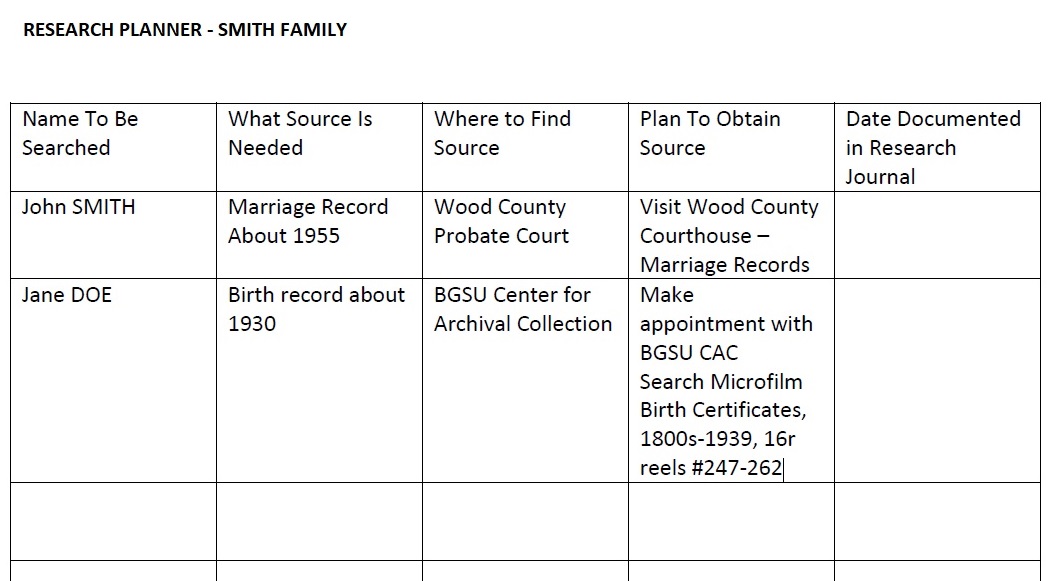
Begin by deciding on which family lines to work on. This will also depend on how much time you have for your trip. You don’t want to over extend yourself and end up not completing your research. Once you have decided on the people it’s time to make a Research Plan!


Check your Family Group sheet & look for the blank spaces that need to be filled. 


List Sources which will help fill these gaps and any pertinent information that will help find the source. Such as, where to find the source, how to obtain it and data which will be necessary when searching, i.e. the titles of books, microfilm numbers, and page & record numbers. 


 To help find this information you have to do your homework. 

 Start by finding out what types of places are available in the area you are visiting. Look for....

  Courthouses 
  State Archives
  Public Libraries 
  Historical Societies/Local History Museums
  Genealogical Society Libraries
  University Libraries 
  Churches 
  Cemetery Offices


Then research each individual place.

What records are available?

What type of fees and cost for records or copies?

Who does the search…you or employee?

What are the hours?

Do you need an appointment? This is especially important now with many offices still only being partially open. 

What are the Rules? i.e. no cameras? No purses? Etc. 


It’s also a good idea to call ahead. You do not want to get there and have it be closed! Ask for any additional information you need that wasn’t available on their website. You may also want to ask them if you need an appointment, how is the parking and do they need to pull the records ahead of time?


                          Use your research planner to create an itinerary.                           
This will help with your time management.  


Remember..research places to stay & area restaurants.                                      


What To Pack?


✔ Documents


It is best if you can keep the information in a "Cloud" so you can access it anywhere. If you do not have the information in a Cloud and/or WIFI is not available, make copies of the records connected to the family. NEVER take the originals. Print out other documents, i.e. family group sheets, and don’t forget the Research Plan & Itinerary.


✔ Equipment


Bring a laptop/Ipod and/or other mobile devices. Phone w/cameras and portable scanners are also useful.


 Odds & Ends

 
  Bring the following list of items to make the trip run smoother. 


✔ Directions


Make sure you have a phone with GPS or a GPS device. I recommend you still take a paper map, some places are outside cell phone service.


And Last but not Least!


 Bring a Traveling Companion


Because it is.... 

• Safer 

• More Fun

• Helpful...who else can find gravestones better than you? 


Now you should be ready! Have a Safe Trip & Happy Researching! 


I would love it if you would leave any tips in the comments that I have not covered. It will be helpful to me and many others! 


Also....here are the answers to the Landmark Contest:  
 

Thank you to the following societies for sending in photographs of landmarks found in their township!

Litchfield Historical Society

Lodi Harrisville Historical Society

Spring Grove Cemetery – Friends of the Cemetery

Brunswick Historical Society

Mortality Schedules - an Alternative to Death Records


Photo courtesy of Linnaea Mallette on PublicDomainPictures.net

Death records of our ancestors are one of the primary sources that family historians are constantly searching for. They can lead to information on other family members, burial sites, cause of death and estate records.

Formal death records are usually available from 1900 onward in the U.S.. A few states, like Ohio, started recording death information in the latter half of the 19th century. Most New England states recorded all vital records much earlier. Tombstones and church records are often used as substitutes for formal death records. 

But what if death record, tombstone or church records aren't available?

Another possible substitute is the Federal Mortality Schedulesif your ancestor died in the 12 months prior to the enumeration of the U.S. Federal Censuses in 1850, 1860, 1870, 1880 and 1885. 

The federal government wasn't receiving information on deaths from the states and they wanted to know causes of death and if certain ages or occupations were more susceptible.  With the Mortality Schedules, the national policy makers had countrywide death statistics for the first time.

What information do they contain?

The information found in the schedules varies with the year and the caprice of the individual enumerators. 

1850-1860 - also only place a slave ancestor's death might be recorded

  • Name 
  • Age at last birthday
  • Sex
  • Race - free or slave
  • Marital status
  • Place of birth
  • Profession, occupation, or trade
  • Length of residence in county
  • Month in which person died
  • Disease or cause of death
  • Number of days ill


1850 Mortality Schedule from Mecklenburg County, North Carolina
NOTE: the red arrow indicates column where free/slave status is listed.
Accessed from Ancestry Library Edition on 7 June 2021.

1850 Mortality Schedule from Woodford County, Kentucky.
This enumerator chose NOT to list enslaved people by name.
Accessed from Ancestry Library Edition on 7 June 2021.

Excerpt from the 1860 Tuscaloosa County, Alabama Mortality Schedule.
Accessed from Ancestry Library Edition on 7 June 2021.

1870
  • If father and/or mother were foreign born
  • Removed the question about how many days the deceased was ill
  • Family number included which ties the entry back to a specific entry in the population schedule. (If it was filled in.)

Excerpt from 1870 Mortality Schedule for Brooklyn, King's County, New York.
Note the columns for if Father or Mother was foreign born. Also note the number of people
who died of contagious diseases, as might be expected in crowded conditions.
Accessed from Ancestry Library Edition on 7 June 2021.

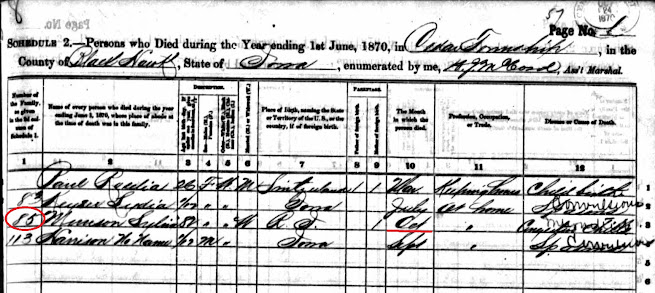
Excerpt from 1870 Mortality Schedule for Cedar Township, Black Hawk County, Iowa.
Note that the individual on the first line does not have a family number associated with her.
Sylvia MUNSON, died in October 10, 1869 (underlined in red) but she was associated with family 
number 85 (red circle) in the 1870 Population Schedule.
Accessed from Ancestry Library Edition on 8 June 2021.

Family #85, Levi and Lucy Ann MUNSON is the household where Sylvia (above) was living at the time of 
her death. Is there a familial relationship?
Accessed from Ancestry Library Edition on 8 June 2021.

1880
  • Place of birth of mother and father
  • How long they had resided in the county
  • Where the disease was contracted if not at place of death
  • Name of attending physician
  • Family number included which ties the entry back to a specific entry in the population schedule. (If it was filled in.)
Excerpt from the 1880 Mortality Schedule for Guyan Twp., Gallia County, Ohio.
John Williams died at the age of 84, the oldest person listed on the page. He and his parents were born in "Virginia". This 
is important because at least one other source lists his birthplace as Pennsylvania. He had resided in Gallia County for 64 years,
giving him an arrival date of 1816, a few years later than the county history claimed. The family he was living with was 
numbered #149
Accessed from Ancestry Library Edition on 8 June 2021.

Strangely, Ancestry Library Edition did not have the image for family #149. There was a gap in their scanned images, jumping from family #143 to #195, and from page 16 of the enumeration schedule to page 23. The image below was taken from FamilySearch.org:

Who is this Rucker family? What is their relationship to John WILLIAMS? Is Susan RUCKER, John's daughter?
Accessed from FamilySearch.org 8 June 2021

1885
  • The Federal government offered to partially reimburse states that wanted to take a census in 1885. Colorado, Florida, Nebraska, and the territories of Dakota and New Mexico participated. However, the territories' mortality schedules are not on Ancestry, FamilySearch or Heritage Quest.
The 1885 Mortality Schedule looks like the earlier ones, but was taken only 5 years after the 1880.
Few states took advantage and even fewer of the schedules survive.
Accessed from Ancestry Library Edition on 8 June 2021.


Where do you find Mortality Schedules?

Ancestry - both Ancestry.com and Ancestry Library Edition


Once you have accessed Ancestry, either through your personal subscription or at a local library, click on Search on the menu bar.


Choose "Census & Voter Lists" from the drop down Menu.


From there, look to the right under "Narrow by Category"


Choose "U.S. Federal Census Collection".


Next scroll towards the bottom and choose "U.S. Federal Census Mortality Schedules, 1850-1885"


That will take you to the page for the schedules. From there, you can browse by selecting year, state and county, or use the main search area to search for an individual name.


HeritageQuest - always free from home by using your library card


HeritageQuest is owned by Ancestry.com and operates in the same way. It does not have all the same data sets as Ancestry, but is a great at-home alternative for census records. 

Once you have accessed HeritageQuest, click on the link on the home page to search the Mortality Schedules. 


FamilySearch 


FamilySearch.org is the free genealogy website provided by the Church of the Latter Day Saints (Mormons) and is available anywhere there is internet access. It requires that you sign up for a free account to view many of the images. No, the free account does not come at the price of being inundated by commercials.
Once you are at the site, choose "Search from the menu.


From the drop down menu, choose "Catalog"

In the "Place" search bar, type in "United States, " followed by the state for your ancestor. Example:
United States, Ohio" and then hit the "Search" bar below.


That displays the page of all of the FamilySearch holdings for that state. Scroll down to the Census entries and choose the year you want.


In the sample below, "United States, Ohio - Census - 1880 (8)" is selected:


This screen shows the selections under that heading. Do not chose the item with an individual's name as the author because that refers to books and manuscripts, most of which have not been microfilmed or digitized. Choose the item where the author is listed as "United States Census Office".


Click on the camera icon to start browsing the digitized microfilm.

If the film is only available to view at a Family Search Affiliate Library, the little camera icon under "Format" will also have a little key next to it. To view this image, visit one of the Medina County District Library branches.

If the Mortality Schedule isn't on any of the big genealogy sites, try these depositories:
  • National Archives - the National Archives has microfilm copies that usually can be ordered. Check out the microfilm catalog in the "Where to Find these Records" box on the right.  Forms that show the column headings for the Mortality Schedules can be found HERE.
  • State historical societies, archives and state libraries. (pp. 24-25 of Stephen Charter's work listed below under Sources)
  • Printed indexes - Check WorldCat to see who owns it. Remember! Printed indexes are a last resort. You always want to see the full document for information not listed in the index.

Coverage/Completeness of the records 

  • These states' mortality schedules are NOT listed on Ancestry or Heritage Quest:
    • Florida
    • Indiana
    • Oregon
    • Rhode Island
    • Vermont, 1850-1860
    • Wisconsin, 1880
  • These states, while not listed on Ancestry/HeritageQuest, ARE HELD at FamilySearch.org:
    • Florida 1860, 1880
    • Indiana, 1860-1880
    • Wisconsin, 1880
  • Before the National Archives was created, the government offered the original mortality schedules to each of the states. If the state did not accept, the manuscripts were sent to the National Library of the Daughters of the American Revolution (DAR).
  • States that were still U.S. territories are not covered.
  • 1870 is missing for 7 states: Delaware, Florida, Indiana, Mississippi, Missouri, Ohio, Rhode Island, Tennessee.
  • The Census Bureau has a list of known coverage of the mortality schedules:  https://www.census.gov/history/pdf/mortality.pdf 

Mortality schedules are useful for documenting documenting Africa American, Chinese, and Native American ancestry as well as tracing epidemics and diseases.

Follow up the information found in the Mortality Schedules by searching for obituaries, mortuary records, cemeteries, and probate records. They can also provide clues to migration points and they supplement information found in the  population schedules.

And as with other census and vital records, your ancestors' deaths may not have been recorded.
 

Sources:


Medina County History Resource Now Available Online!

Medina County District Library is excited to announce that their local history collection "Medina Landmarks / About the Past" has ...