Abbott & Costello Go to Medina
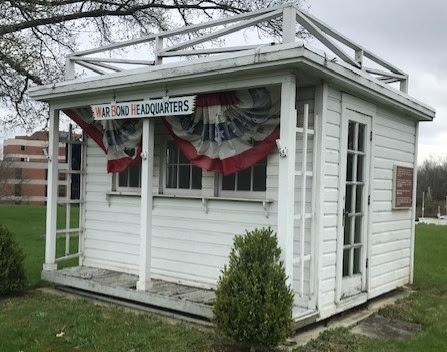
It began when a group of volunteers built a small, white building to sell War Bonds, stamps and corsages here in Medina, Ohio.
By Lauren Kuntzman
In honor of Veterans Day, this week’s blog post will focus on the history of the Honor Roll Board of service members from Medina and Montville Townships in WWII.
American Legion Takes the Lead
Ten months after the attack on Pearl Harbor and the United States’ entry into WWII, members of the local American Legion post initiated efforts to create an “Honor Roll Board” of service members from Medina village, Medina Township, and Montville Township. Post leader Perry Smith formed a committee of members, including Cloyd Derhammer, Clayton Randall, and Neal Roshon.
Derhammer, Randall, and Roshon were to collect the names of individuals who were currently serving or had already served in WWII and had been honorably discharged. These names were to be inscribed on a sign, mounted on the side of the B. & L. Store, located at 201 S. Court Street (the site of Lemonberry Frozen Yogurt today). Local businessmen funded the building and installation of the sign. The sign was designed by local sign painter Franklin Bates. Bates planned for it to hold 1,000 names and inscribed the names collected in the first round of the project.
Criteria to be Included on the Honor Roll Board
To be named on the list, individuals had to be…
a resident of Medina Township, Montville Township, or Medina Village.
currently serving in a branch of the military or…
a veteran of WWII and honorably discharged from service.
Individuals also had to be “sponsored” by a relative. Sponsorship had no financial component – it was free for all service members to be added to the Honor Roll – but took the form of a written statement with the individual’s name, address, and branch of service. It was hoped that the “sponsorship” model would reduce duplicates, omissions, and errors.
In the committee’s initial call for names, written statements were to be submitted by October 1, 1942. They hoped to dedicate the Honor Roll on Armistice Day 1942.
The List Grows
The process of collecting service members’ names took longer than anticipated. It wasn’t until April 1943 that it was considered to be “up-to-date.”
Additional individuals would be added to the list when they entered the service and the American Legion committee continued to collect names. Here is a brief timeline of its growth:
![]() |
| Virginia (Wheeler) Martin, benefactor of MCDL's Family History & Learning Center was one of the painters to add names to the Honor Roll Board. |
July 1943 - 514 names - Sign Painter: Robert High
February 1944 - 596 names - Sign Painter: Robert High
May 1944 - 622 names - Sign Painter: Virginia Wheeler
August 1945 - 757 names - Sign Painter: Emil Gnuschke
Over time, the Honor Roll also came to include women. The three local women serving as WAVES (Women Accepted for Volunteer Emergency Service) in the US Naval Reserve were Eleanor Brandt, Lois Kaden, and Pearl Seller. Army Nurse Elizabeth Mettie was also added to the Honor Roll.
As time passed, some of those noted on the Honor Roll lost their lives. At first, gold crosses were painted in front of the names of individuals who gave their lives in the war. Later these individuals were identified with gold stars.
The War and the Honor Roll Board Come to an End
By the end of the war in September 1945, 761 residents of Medina village, Medina Township, and Montville Township were named on the Honor Roll Board. The sign remained in place at South Court Street but, over time, came to need repainting and repair. It was ultimately decided that the Honor Roll Board should be part of the Memorial Day exercises in 1947 and then removed.
Learn More
To learn more about the Honor Roll Board, visit https://mcdl.info/newspapers and view the following issues of the Medina Gazette:
11 September 1942, p. 1
22 September 1942, p. 1
23 October 1942, p. 1
23 April 1943, p. 1
6 July 1943, p. 1
24 August 1943, p. 1
1 February 1944, p. 1
23 May 1944, p. 1
5 June 1945, p. 1
20 July 1945, p. 1
25 September 1945, p. 1
4 February 1947, p. 6
27 May 1947, p. 1
18 April 1947, p. 1
20 May 1947, p. 1
3 June 1947, p. 8
Research can often turn up the strangest of stories. For example, how cemeteries can be frightful and that being laid to rest might not be the end of your mortal body's journey. According to Medina County’s ‘Timeline of Medina County History’ created by Stephen Hambley, back in 1870 Ohio was plagued with “organized gangs of grave robbers”. The gangs of grave robbers tended to be made up of either medical students or individuals looking to make a profit from selling bodies to medical colleges.
To investigate the cemeteries and reports of missing bodies here in Medina County and broader Ohio, you can start with Digital Archives of Medina County District Library. When using this database search using keywords such as “body snatchers” “grave robbers” and a single name “Jonathan Barker.”
The trail begins in 1877 on January 12th, when the Medina County Gazette published the obituary of 79-year-old Jonathan Barker, laid to rest in Windfall Cemetery.
![]() |
| MCG 11/21/1877, p5 |
One of his children made a plea that if her father’s body was returned without harm all charges would be dropped. The next day a note was left on her doorstep that her father could be found at the cemetery. Mr. Barker’s body was returned to the grave site in a new suit and coffin.
![]() |
| MCG 02/21/1877, p2 |
While searching for Damon and medical students involved in grave robberies, an article was found with the name John Scott Harrison.
John Scott Harrison was the father of President Benjamin Harrison. The small article in the Gazette said that J. Harrison was found by his son in a medical college hanging from a rope. Unable to find further insight into the incident in the Medina County Gazette, it was time to turn to another source for information. Using the archives and resources available through the Benjamin Harrison Presidential Site, you can search ‘J. S. Harrison’ and find an article dedicated to the events of his grave robbery.
![]() |
| MCG 06/07/1878, p2 |
In 1878 J. Harrison’s three sons arrived for their father’s funeral only to notice the grave of a nephew, Augustus Devin, had been ransacked. After taking precautions with their father's grave, John Harrison II, along with a cousin went on the hunt for poor Augustus. The Benjamin Harrison Presidential Site expands on the Medina County Gazette article mentioned earlier. This article reported that a veiled body was hanging inside a shute used to lower cadavers to different exam rooms. When unveiled, it was a shock to find John Scott Harrison who had been buried, and whose grave was heavily reinforced with stone and cement not long before, hanging from the end.
There are no reports of how or who took J. Harrison’s body from his grave to the medical college. The only thing that is known is that in the late 1800’s medical colleges and their students were the leading suspects due to the lack of bodies being donated to science. The body of Augustus Devin was later found among many others at Anne Arbor Medical College.
![]() |
| MCG 09/06/1878, p4 |
However, medical colleges are not the only place thieves tried to get money out of stealing bodies. Six years after J. Harrison a body was stolen in Medina and an attempt to ransom it back to the family was made.
Linus Smith was the son of Medina pioneer Fairfax Smith. He lived on his father’s farmland, where a family vault was on site. The vault was built in 1880 and was only home to Fairfax, his wife, and a boy, Linus’ brother.
![]() |
| Photo by Madison Thomas 10/25/2022 |
For anyone curious, the families plot is easy to find in Spring Grove Cemetery today. It is clearly marked with one of the cemetery’s more notable grave markers, a marble statue ordered by Linus straight from Italy to honor his father Fairfax and the early pioneer way of life.
Today we have systems and ways of donating our bodies to science and few need worry about the possibility of grave robbery. Using our newspaper resources like Digital Archives of Medina County District Library, Family History & Learning Center hanging files, and follow-up resources like the Benjamin Harrison Presidential Library can give insight into life in the 1800’s. So much of life then is different from how it is today. Due to two out of three of these grave robberies dropping charges the few remaining records we have of the events are newspaper articles. With those few tools we can follow the unfolding of a fascinating tale and struggle within Ohio to keep its dead...buried.
Hambley, Stephen D. (2018). Timeline of Medina County History, Slide 33. Medina County Ohio. https://www.medinaco.org/wp-content/uploads/2021/11/2018-Remastered-Timeline.pdf. Accessed 1 October.
Medina County Gazette. The Digital Archives of Medina County District Library. http://mcdl.advantage-preservation.com/ . Accessed 5 October 2022.
01/26/1877, p5
01/12/1877, p5
11/30/1883, p5
02/12/1877, p5
02/20/1877, p2
06/27/1878, p2
06/07/1878, p 2
09/27/1878, p4
09/06/1878, p4
Medina Highschool Class of 1966. (1966). Historical Highlights of Medina. Medina High School. (E. I. Schapiro, Ed.). A. Meyers Lithographers.
Price, A. (2019). The Grave Robbing of Benjamin Harrison’s Father. Benjamin Harrison Presidential Site. https://bhpsite.org/the-grave-robbing-of-benjamin-harrisons-father/ . Accessed 4 October 2022.
Virginia Wheeler Martin Family History and Learning Center (n.d.). Hanging Files: Cemetery Smith Monument. Medina County District Library.
Medina County District Library is excited to announce that their local history collection "Medina Landmarks / About the Past" has ...